This week marks the 2014 Global Youth Service Day (GYSD), which celebrates and mobilizes the millions
of young people who improve their communities each day of the year
through service. This special day is celebrated each year in more than 135 countries, with young people working together - alongside schools, youth organizations, civil society organizations, government agencies, national service programs, and more - to address the world's most critical issues and change their communities. Established in 1988, Global Youth Service Day is the
largest service event in the world, and the only day of service
dedicated to children and youth. While this day has always been near to my heart, it is extra special this year because I am actively participating in it.
Yesterday I was contacted by a press officer from Peace Corps Headquarters inviting me to be teleconferenced in to the Global Youth Service Day Conference being held in Washington DC. Two other PCVs and I will be broadcast live to the National Mall to talk about our service and do a Q&A for viewers. We will represent the 7,209 currently serving Peace Corps and, hopefully, inspire youth to continue giving back to this interconnected global community. Wow.
I feel very honored and extremely humbled to have been asked and a little bit intimidated by the task. But I am up to the challenge. I am inspired every day by the work we are doing abroad and I believe in the capacity we each have to help. I have seen the impact in Botswana. This is my chance to share it with a much larger group at home. How very exciting!
If you want to learn more about GYSD, please check out their website at http://www.gysd.org/ and if you're in the Washington DC area on Friday and see my face up on the screen, send me a wave!

Showing posts with label Development. Show all posts
Showing posts with label Development. Show all posts
Wednesday, April 9, 2014

Friday, March 7, 2014
IECD and LS Technical Working Retreat
Much of my work at PCI has been focused on integrated early childhood development (IECD) and life skills (LS). I have been working very hard to improve the lives of young children and adolescents in Botswana by creating better systems and resources and enhancing the access to and understanding of programs for the most rural and vulnerable communities. As part of this effort, I have conducted focus groups on effective facilitation of LS material (LS topics include communication, self-esteem and awareness, critical thinking, and so on), lead workshops for single teenage mothers, met with stakeholders and partners from across the country, providing technical assistance to civil society organizations working in these areas, and drafted and compiled concept notes and resource books set for publication on both IECD and LS.
This last project is of particular note because it was a catalyst for a workshop eleven years in the making. Yes, eleven.
In 2003, the Botswana Government partnered with UNICEF to analyze the IECD and LS programs. They found both to be lacking and called for a technical team to be constructed and a way forward agreed upon. To date, nothing of substance has been done to address this mandate. They have, however, created "frameworks", which essentially are merely outlines, of what the desired outcomes would be for IECD and LS programs for children and adolescents. There were many MANY gaps left to be filled in and the right players had not stepped up to the plate.
Our week-long "technical working retreat", as we called it, brought heads of Government Ministries and stakeholders together to accomplish a handful of very important objectives. Of note: finally addressing the challenges and gaps with IECD and LS in Botswana; determining who is responsible for various components of these programs; reviewing the documents PCI and I proposed (which should act as the "filler" for the frameworks); and making technical, policy, and advocacy recommendations for national program revisions. We wanted people to understand what was going on, to take ownership over the situation and their roles, and to create a plan for what our ideal "model" would be for IECD and LS. This was an invariable who's who of leaders in their fields and they were poised and ready to tackle these hard issues. After eleven years of waiting, we made it happen.
Without going into too much detail about the five days (for fear of boring you with jargon and nitty gritty), I want to say that the retreat was an overwhelming success. The background was given, the studies were read, and a greater understanding was reached. The people became instantly motivated to make a change. We were able to have the conversations with all the right parties present and really hash out the intricacies of what works, what doesn't, and what we would like to see in IECD and LS education, especially for those most marginalized populations. And we did it in front of each other, meaning there should be accountability as we move forward. Basically, the environment was right. We now have task forces set up to deal with smaller issues and we have a larger plan for tackling the entire project. We are on the same page.
In the months before I close my service and finish my time with PCI, I will be packaging the ideas for our model program into something that can be discussed, marketed, and implemented, as well as meeting with all of the task forces to monitor their progress in addressing the key issues agreed upon at the retreat and finalizing the documents I have been working on and beginning to train partners and stakeholders on how to use them. There is still so much to be done but we are on the right track.
And what a beautiful place to be doing this all in...

This last project is of particular note because it was a catalyst for a workshop eleven years in the making. Yes, eleven.
In 2003, the Botswana Government partnered with UNICEF to analyze the IECD and LS programs. They found both to be lacking and called for a technical team to be constructed and a way forward agreed upon. To date, nothing of substance has been done to address this mandate. They have, however, created "frameworks", which essentially are merely outlines, of what the desired outcomes would be for IECD and LS programs for children and adolescents. There were many MANY gaps left to be filled in and the right players had not stepped up to the plate.
Our week-long "technical working retreat", as we called it, brought heads of Government Ministries and stakeholders together to accomplish a handful of very important objectives. Of note: finally addressing the challenges and gaps with IECD and LS in Botswana; determining who is responsible for various components of these programs; reviewing the documents PCI and I proposed (which should act as the "filler" for the frameworks); and making technical, policy, and advocacy recommendations for national program revisions. We wanted people to understand what was going on, to take ownership over the situation and their roles, and to create a plan for what our ideal "model" would be for IECD and LS. This was an invariable who's who of leaders in their fields and they were poised and ready to tackle these hard issues. After eleven years of waiting, we made it happen.
Without going into too much detail about the five days (for fear of boring you with jargon and nitty gritty), I want to say that the retreat was an overwhelming success. The background was given, the studies were read, and a greater understanding was reached. The people became instantly motivated to make a change. We were able to have the conversations with all the right parties present and really hash out the intricacies of what works, what doesn't, and what we would like to see in IECD and LS education, especially for those most marginalized populations. And we did it in front of each other, meaning there should be accountability as we move forward. Basically, the environment was right. We now have task forces set up to deal with smaller issues and we have a larger plan for tackling the entire project. We are on the same page.
In the months before I close my service and finish my time with PCI, I will be packaging the ideas for our model program into something that can be discussed, marketed, and implemented, as well as meeting with all of the task forces to monitor their progress in addressing the key issues agreed upon at the retreat and finalizing the documents I have been working on and beginning to train partners and stakeholders on how to use them. There is still so much to be done but we are on the right track.
And what a beautiful place to be doing this all in...
Tuesday, February 11, 2014
Young Single Mothers Workshop
We all too often take for granted things that shape who we are. Things like upbringing, presence of supportive caregivers and adults, nutrition, and friends. But what if these things didn't exist in our lives? Or if they were offered in fragments and then taken away from you? What if you were an orphan and raised yourself? There are lessons learned in life that naturally happen in so many of our homes and schools that we don't even recognize. What happens when people don't learn how to communicate effectively or care for their basic needs? I am now much more conscious of that reality, as it is the basis for much of the work I have been doing in the past months. This has given me the opportunity to delve deeper into the issues facing the youth of Botswana, in particular, young women.

Twenty-three young single mothers turned up for the two-day workshop run by one of our implementing partners in a nearby village. I was invited to attend to support the partner and assist in facilitating sessions on self-awareness, self-esteem, and communication. I was joined by two other members of the PCI team and some nurses from the local clinic, who were scheduled to discuss sexual reproductive health and topics on caring for young children.
 The workshop was designed to be participatory, encouraging the young women to search for their own solutions and to create a sense of community among those in similar circumstance. As such, activities were collaborative, involving a lot of group work and discussions, and the women were challenged to work through differences in order to create viable options for their collective future. This meant focusing on problem solving, planning, and critical thinking - all of which are often neglected in a country that prides its education system on rote memorization.
Overcoming the challenges of the workshop model was met first with argument and then, in time, with laughter. The latter lead to dialogue that brought great results and the girls began to prosper. It wasn't long before the women were opening up and starting to acknowledge some of their commonalities (something we believe will unite them and give them strength). It was empowering to witness.
 In the end, the women made great strides in both their approach to examining and addressing issues, as well as in creating a team among one another. They were able to learn from one another and, thereby teaching them lessons long deprived. What's more, the partner organization gained the experience in facilitating a workshop of this nature and have vowed to follow the women and support them as they work towards implementing some of the activities they decided, as a team, to go for. They are no longer orphans, alone, trying to overcome hardship and raise children. They are together.
This is the sort of sustainable development that we always hope for - the kind where people learn how to help themselves and local organizations gain the skills necessary to support those efforts. I am going to be mentoring this organization for the final months of my contract but I am confident in their ability to continue in this manner. I am just proud to be there to witness it.
Twenty-three young single mothers turned up for the two-day workshop run by one of our implementing partners in a nearby village. I was invited to attend to support the partner and assist in facilitating sessions on self-awareness, self-esteem, and communication. I was joined by two other members of the PCI team and some nurses from the local clinic, who were scheduled to discuss sexual reproductive health and topics on caring for young children.
Overcoming the challenges of the workshop model was met first with argument and then, in time, with laughter. The latter lead to dialogue that brought great results and the girls began to prosper. It wasn't long before the women were opening up and starting to acknowledge some of their commonalities (something we believe will unite them and give them strength). It was empowering to witness.
This is the sort of sustainable development that we always hope for - the kind where people learn how to help themselves and local organizations gain the skills necessary to support those efforts. I am going to be mentoring this organization for the final months of my contract but I am confident in their ability to continue in this manner. I am just proud to be there to witness it.
"Be content with what you have; rejoice in the way things are.
When you realize there is nothing lacking, the whole world belongs to you."
Wednesday, February 5, 2014
“There is some good in this world, and it's worth fighting for.”
Even among employees and organizations that are qualified, passionate, and maintain strong values, apathy and atrophy tend to set in from time-to-time. It is a disheartening truth that impacts the quality and amount of work that is able to be done. Sometimes, when these infect a single (but key) person, the ripple effect can be great. These negative attributes, then, can lead to an under-utilization of motivated human resources or a withdrawal of those resources altogether. This is the reality I have been facing.
I have spent the last few months as a stunted version of myself. I have felt somewhat ineffectual in carrying out significant meaningful work within my primary assignment and have struggled to find a way to make a contribution within the confines outlined to me. Simply, I didn't have the freedom to create the change I wanted - and have become accustomed to - and I saw myself falling into professional doldrums.
That is not to say I have been stagnant. Besides my work for Peace Corps (as a Volunteer Leader), I have, in fact, been working on a couple large scale projects that stand to be extremely influential in the future. These include a Life Skills Toolkit and an IECD Resource Pack, both to be published and adopted by the Government of Botswana to strengthen its current National Strategies. Unfortunately, despite my dedication to these efforts, my work was constantly being put on hold in favor of, what seemed to be, waiting around for others to get motivated and involved enough to sign off on my (finished) work. This has caused me great frustration. I hold myself to a certain standard of giving back and helping others and have dedicated myself to that. Not being able to achieve to my full potential is a difficult pill to swallow, especially when you want it so badly.
Something had to be done. And now.
So I had a few conversations - conversations with colleagues that led to conversations with my superiors at Peace Corps that culminated in some very staunch heart-to-hearts with my counterparts and supervisors at my primary assignment. While the conversations were difficult, I am optimistic that positive change is on the way. Why am I so optimistic? Because I am no longer directly tethered to others within my agency so what happens next is up to me.
I am now taking over and managing a number of fairly high profile national projects and have been granted independence to build capacity of implementing partners across the country. This means I can go out in a technical capacity and work directly with the providers in the field to help them integrate and actualize programming, as well as strengthen systems and organizational capacity in order to improve service delivery. Working directly with the implementing partners is a resource and valuable experience both for me and for the organizations I now have the authority to work with. And the quality and level of my involvement is mine alone to determine, with the support of my counterpart, her supervisor, and the agency as a whole. Hallelujah! I am finally free to start making an impact in a much more meaningful way again! Good news all around!
I have spent the last few months as a stunted version of myself. I have felt somewhat ineffectual in carrying out significant meaningful work within my primary assignment and have struggled to find a way to make a contribution within the confines outlined to me. Simply, I didn't have the freedom to create the change I wanted - and have become accustomed to - and I saw myself falling into professional doldrums.
That is not to say I have been stagnant. Besides my work for Peace Corps (as a Volunteer Leader), I have, in fact, been working on a couple large scale projects that stand to be extremely influential in the future. These include a Life Skills Toolkit and an IECD Resource Pack, both to be published and adopted by the Government of Botswana to strengthen its current National Strategies. Unfortunately, despite my dedication to these efforts, my work was constantly being put on hold in favor of, what seemed to be, waiting around for others to get motivated and involved enough to sign off on my (finished) work. This has caused me great frustration. I hold myself to a certain standard of giving back and helping others and have dedicated myself to that. Not being able to achieve to my full potential is a difficult pill to swallow, especially when you want it so badly.
Something had to be done. And now.
So I had a few conversations - conversations with colleagues that led to conversations with my superiors at Peace Corps that culminated in some very staunch heart-to-hearts with my counterparts and supervisors at my primary assignment. While the conversations were difficult, I am optimistic that positive change is on the way. Why am I so optimistic? Because I am no longer directly tethered to others within my agency so what happens next is up to me.
I am now taking over and managing a number of fairly high profile national projects and have been granted independence to build capacity of implementing partners across the country. This means I can go out in a technical capacity and work directly with the providers in the field to help them integrate and actualize programming, as well as strengthen systems and organizational capacity in order to improve service delivery. Working directly with the implementing partners is a resource and valuable experience both for me and for the organizations I now have the authority to work with. And the quality and level of my involvement is mine alone to determine, with the support of my counterpart, her supervisor, and the agency as a whole. Hallelujah! I am finally free to start making an impact in a much more meaningful way again! Good news all around!
Friday, January 31, 2014
Another PAC Meeting
The quarterly meeting for Peace Corps Botswana's Project Advisory Committee (PAC) Meeting was held yesterday. Leaders from the Government Ministries, the National AIDS Coordinating Agency (NACA), Peace Corps staff, and other relevant stakeholders came together to discuss our post's program and build on previous meetings. This meeting is invaluable for sharing information and improve both relations with these parties and the quality of our service to the country. Simply being a representative is an honor. This meeting, however, my Country Director asked me to step up and present to the group.
My task was to present examples and best practices of volunteer activities across the different sectors (Local Government Capacity Building, Community Health Team, Non-Governmental Organizations, and Life Skills). This meant scanning the work done by 134 PCVs and isolating projects that would be of interest, both because of their direct relevance to the PAC members and to demonstrate alternative types of projects volunteers participate in that have a significant impact on their communities. (I have to state that this was no easy task because PCVs in Botswana are doing some very good work!) I then created a presentation to accompany my discussion and prepared for what I assumed would include an onslaught of questions by the PAC members. This was going to be a very big meeting for me - presenting and honoring the work of my fellow volunteers to such high level officials within Botswana. If I'm being honest, this means I fretted about it.
I needn't have worried, however. My presentation went smoothly, the PAC members were extremely impressed with PCV activities around the country, and Peace Corps staff were happy with how I portrayed our work. In fact, they were so pleased with it that they sent my presentation back to Peace Corps Headquarters in Washington DC to show the type and quality of activities going on at our post! It was a proud day for me. I was proud of myself for a successful presentation in the face of these bigwigs and proud of my colleagues and friends for all of the great things they are doing. It was an honor and a privilege to share their work with PAC.
I needn't have worried, however. My presentation went smoothly, the PAC members were extremely impressed with PCV activities around the country, and Peace Corps staff were happy with how I portrayed our work. In fact, they were so pleased with it that they sent my presentation back to Peace Corps Headquarters in Washington DC to show the type and quality of activities going on at our post! It was a proud day for me. I was proud of myself for a successful presentation in the face of these bigwigs and proud of my colleagues and friends for all of the great things they are doing. It was an honor and a privilege to share their work with PAC.
Monday, January 27, 2014
Dan Pallotta: The Way We Think About Charity Is Dead Wrong
Those of us working in the non-profit or development sectors will shake their heads in agreement or maybe tear up a few times at this TED Talk. My hope for it is that more people take the time to watch it and internalize what Mr. Pallotta is saying and then start a conversation that will help spread the message. We can be the generation that makes real and lasting change but it has to start with a perpective shift. Give it a shot. It will be a worthwhile nineteen minutes in your day.
Monday, December 2, 2013
Officially Saying Goodbye To GCHBC (Protocol Observed)
 Apparently, even going away parties operate on "African Time" in Botswana so it is a darn good thing that I stuck around for a third year or they would have needed to have it without me! Nearly six months to the day since I moved out of Gabane, I was honored with a very special "Farewell Kamogelo" event at Gabane Community Home-Based Care.
Let me set the stage...
The event, which was held at the center, was attended by the GCHBC staff and board, the home-based care volunteers, the District AIDS Coordinator, district counsellors, the village chief (Kgosi), clinic and health post staff, community members, and a number of people I worked with on various projects. While everyone showed up on time (a huge feat), the event still started nearly two hours late. Conversation filled the time, though, so it went by as if only a moment passed. The room was overflowing with smiles, laughter, song, and dance. The smell of my favorite Setswana dishes traveled out of the kitchen (with happy cooks exclaiming that the vegetables were from the garden we built, a fact they knew would make me exceedingly happy). And the tables were covered with shiny linens in white and purple, expertly ruffled so it looked like flower blossoms adorned them. The atmosphere was stunning and the energy nearly took my breath away.
 The event had a formal component, where I sat at the head table and heart-felt speeches were given. Among them was a speech given by the center's coordinator, Mma Leburu. She spoke first in Setswana and then repeated in English, making sure I heard her words. Her oration brought tears to my eyes. She talked about the challenges we overcame, the work we did, and the skills they now have. She had people from the audience stand in acknowledgement as she told stories about projects I had worked on. For instance, the family we built the home for, children and all, stood as she talked about that effort and the School Heads from the primary schools when we discussed my ongoing caregiver training and support project. As they stood, they blew kisses and bowed in my direction. I couldn't help but tear up at this gesture. Compliments were paid to me that humbled me beyond compare. And then, perhaps the best compliment was made to me as Mma Leburu said:
 "Kamogelo, you never judged us or looked down on us for our lack of education or experience. You just held our hand and believed in us. Because of you, because of your kindess, and because of your love, we now see in ourselves everything that you always told us we were. You were our gift. We love you."And, with that, ululations exploded from the crowd, I burst into tears, and I lept out of my chair and ran over to Mma Leburu and hugged her a half dozen times before walking throughout the room to give hugs to everyone there.
While I finished handing out my hugs, everyone began to sing and wave and point at me. The lyrics to the song, which were exceptionally poignant, were (translated from Setswana): "Go well my lady, go well, but don't every forget us!" As they sang, I kept thinking, How could I ever forget these people?!

During their song, Sebina (my counterpart and one of the staff from the center) slowly brought a giant wrapped present over to me. The moment she laid it on the table, she began to unwrap it, too excited to wait on me. As the hand-decorated brown paper fell to the side, pottery was revealed! It was an entire tea set made by my friends at the Pelegano pottery place! A tea pot, six cups and saucers, a sugar pot, and a milk pitcher! As I gasp with surprise and awe (since this was a set that I had looked at purchasing for some time), Sebina whispered "I know you love this. It matches the big coffee mugs you already have. I remembered!" And then she smiled ear-to-ear as I jumped around thanking everyone for their generosity.
 Moments later, Sebina was handing me another gift, which was just from her with a note attached to it. While the gift was beautiful (a red vase), the note was exponentially more special. I hugged her again to let her know how much it meant to me and, as I did, she said "I will never forget your hugs." So I hugged her again.
The entire day was a reminder about all the things that made my Peace Corps service so special - these ladies, this community, and our relationship. This was what my service was about and no one can ever take that away from us. It is something I will never forget. And now it is something that I know they will never forget either. It brought so much joy to me to have that closure with them and the acknowledgement of everything we shared. I kept thinking about how lucky I was to still be in the country to have this time together and this experience, and I wondered how many volunteers never get the chance for this. After all, I "should have" been gone six months ago... So, to those who left without a party or without hearing these words, I hope you know that your service mattered and you inevitably touched people beyond recognition. Sometimes it just takes them a little while to sort through it all and find the words. Two years just isn't enough.
Thursday, September 5, 2013
Educating Towards A Better Tomorrow

In my role with PCI, I am entrusted with putting together a Life Skills Toolkit. The vision for the project is to create a guidebook to assist life skills facilitators with imparting knowledge onto learners by providing them with clear information and, essentially, a packet of hands-on activities and lesson plans aligned to the framework. It is the hope of PCI that this toolkit will enhance the Life Skills program and make it even more effective. As such, they intend to publish it and roll it out on a national level. This is a huge project to be involved with.
As such, I have been conducting focus groups with Batswana and have called on the experience of my colleagues who have been working within the youth development sector in Botswana - they are the experts in the field and can offer insight into best practices within the Life Skills program. It is my belief that the most rich product will be one that incorporates real-world experience with technical theory.
I am happy to report that development of the toolkit is moving along smoothly and we already have 170 pages stocked with descriptions of topics and key terms, as well as lesson plans on topics ranging from how to effectively facilitate sessions for children and young adults to compulsory content like: sexual and reproductive health, STIs, and HIV/AIDS; life skills (communication, critical thinking, goal setting, decision making, managing stress/grief/pressures, etc); values; health and safety; human rights; and finally how to monitor and evaluate your program. By November, the toolkit should be ready to go to print and hopefully there will be a national campaign by the first of the new year.
Here's hoping that 2014 brings about a more complete Life Skills program as a result of this project.
Sunday, September 1, 2013
Finishing Up: Gabane Community Home-Based Care
Yesterday was a truly epic day. It was a day when I got to witness the end-game of my work at Gabane Community Home-Based Care (GCHBC). And, what makes it even more memorable and exciting, is that I got to do it in the form of an amazing event, alongside all the people who were part of those efforts from the community at large. My heart will be overflowing with joy, pride, and gratitude when I think about this day for the rest of my life. What was supposed to be a small event became something so much more.
A few days ago, the coordinator from GCHBC called to let me know there was going to be an event to hand over and unveil a brand new playground at the center. This had been a last-minute project that I pursued, mere weeks before I finished my time in Gabane and went for home leave. Although PCVs are encouraged not to start anything new at the end of their service, I believe that when opportunities present themselves it is important to grab them, so we made the effort. Getting the playground would offer a safe place for the children to hang out and have fun, as our previous one was dilapidated and in great need of repair. Two days before I left, I received word that our proposal was accepted and representatives from a local bank branch would be sponsoring the playground. Over the past two months, this effort came to fruition. And yesterday, I got to see the labor of love and watch the children's eyes light up when they saw their new play area.
I was so overwhelmed with love when I arrived at the center. I had been gone for two months and hadn't seen my Botswana family in as long. Hugs were the first thing on the agenda. But, not long after our familial embraces, I was sneaking around the event tents, media, and special guests, towards the new playground. I couldn't wait until the unveiling. I had to see it now!
 When I saw the new playground, I could hardly believe my eyes! The new playground has swings, a climbing wall, teeter-totters, a bridge, slides, and an in-ground trampoline! And it was all new! And beautiful! I nearly burst into tears imagining the kids seeing it - how was I going to react when that time actually came?! I mean, who actually has an in-ground trampoline at their preschool center? It seemed impossible. This was just too magnificent to behold.
I went to run over to the ladies to gush about the playground but was intercepted by the donor, who I immediately hugged. She laughed and laughed because my excitement and my gratitude was so palpable. I hadn't seen the plans for the playground before I left so it was a complete surprise to me. It exceeded all of my hopes and expectations. I knew the children's reaction would be even more amazing.
Finally, after a few words with the donor, I went in search of the ladies from the center. As I rounded the corner of the event tent, I saw it. There, parked in front of me, was the combi we had written a proposal for many months prior! SURPRISE!
 No one knew it was coming. FNB Foundation, who we were awarded the combi through, had talked to the bank branch weeks before and asked to surprise us with the combi at the handing over ceremony. And surprised we were! I honestly couldn't believe my eyes! Everyone must have been waiting for my reaction because, as I squealed with joy and shock, I turned around to see all the staff and donors laughing and smiling. IT WAS HERE!!! THE COMBI WAS HERE!!! And it, too, was beautiful!!! Goodbye old combi! Goodbye spending 47% of our funds on vehicle repairs! HELLLLOOOOOO riding in personalized style! WE HAVE A BRAND NEW COMBI! The combi was the last out-standing award I was waiting for to complete my time at Gabane Community Home-Based Care. I needn't wait any longer!
And all of this happened BEFORE the actual event and handing over ceremony!
The event was well attended. Our Kgosi and Minister of Parliament were there, as were the heads of the donor agencies and our entire board. The community came out in hordes. Every major village organization was represented - the clinic, health post, support group, school heads, and the other NGO in the village. Everyone who had been a part of my service in Gabane was there. And, over and above, the media came out to photograph and televise the event. It was truly spectacular. I couldn't have asked for a better group of people to be in attendance. The represented everyone that was part of time in Gabane.
On a very personal note, during his speech, the board chairperson made a very special "thank you" address to me for my efforts with the center. His words were kind beyond compare. He then asked me to stand. Everyone applauded me and the children came rushing over and hugged me. I was overwhelmed to the point that tears welled up in my eyes. To me, the only reason I was able to achieve so much was because I had a great team alongside me. They worked so hard and absorbed all I had to share with them. It was a joint effort. But I was so grateful for the acknowledgement and pleased they spoke so highly of me. I, of course, think the world of him and the ladies at the center.
 As an added surprise, the donors also presented fleece blankets and small mattresses for each and every child in the center (54 of them!!!). The children clung to these blankets (which were a great gift, especially with how cold it was yesterday), even as they saw the playground for the first time. It was adorable watching them try to run to the playground and jump on the trampoline and climb the ramp with their blankets in tow. But they were just too excited to part with anything. Precious.
(Side note: When I went into the classroom to greet the children before the event started, they came running over shouting "Kamogelo! Kamogelo" and all wanted to do our "secret handshake". It warmed my heart that they still remembered everything because it was so special to me. And, I know you're likely thinking "But, Tija, it's only been two months, how could they forget?" Well, humans are incredibly resilient. Now apply that to 3-year-old orphans. I left them and was worried they would have blocked it all out in the name of self preservation. I am happy to report that they haven't. Smiles all around!)
 After the event, I took some time to walk around the center and check out a number of projects we had done during my service, including the garden. Nearly a year later, the garden is thriving. The center feeds only from there now and it is still producing enough for income generation. It was amazing to see the plants flourishing. I was proud that the staff at the center were keeping up with it and, if anything, had improved the already gorgeous garden. It also a relief to see that nutrition is now taking a front stage in the efforts of the center's work towards helping the children and the home-based care patients.
 The same goes for the new fruit tree orchard. This was a slower effort, but potentially more sustainable in the long-term. We grew these from tiny saplings that had been donated by a local greenhouse. There are now nearly twenty fruit trees - papaya, mango, and orange - that accompany our bustling garden. Small buds are beginning to flower on the trees, as the first signs that fruit will come. This is a joyous sight. And, if I may get sentimental for a moment, these trees are representative of our joint efforts at the center. They started out small and we weren't sure what would come of them. But then they were planted and nourished and strong roots began to take hold - a foundation for growth. Now they are strong and the potential limitless. How wonderful to witness.
As I walked into the office after witnessing the event, our awards, and the progress made in the fields around the center, the coordinator impressed me yet another time. She pulled out a new financial report they had made, unassisted, in preparation for an upcoming audit. The report was beautiful. They had learned everything I had shown them and were able to do it all on their own. There were QuickBooks reports and breakdowns and everything was substantiated with perfectly organized ledgers and more. I knew they could do it but it took my breath away to see the end result.
Lastly, the ladies announced that they refurbished a proposal I had written months ago and submitted it to a local foundation. They are meeting with a foundation representative next week about being awarded sponsorship for the next three years. If this happens, the center stands to receive upwards of P1.2 million to support its programs. That would give them the resources to grow the preschool, implement the Kids Club, and expand its reach to help even more people. I am so proud of the ladies for taking the initiative to pursue this opportunity. They are stronger than ever and ready to push forward to a new level. I am blessed to have been a part of their journey to now.
In the words of the coordinator, "All that's left to do is sing and dance and celebrate!"
A few days ago, the coordinator from GCHBC called to let me know there was going to be an event to hand over and unveil a brand new playground at the center. This had been a last-minute project that I pursued, mere weeks before I finished my time in Gabane and went for home leave. Although PCVs are encouraged not to start anything new at the end of their service, I believe that when opportunities present themselves it is important to grab them, so we made the effort. Getting the playground would offer a safe place for the children to hang out and have fun, as our previous one was dilapidated and in great need of repair. Two days before I left, I received word that our proposal was accepted and representatives from a local bank branch would be sponsoring the playground. Over the past two months, this effort came to fruition. And yesterday, I got to see the labor of love and watch the children's eyes light up when they saw their new play area.
I was so overwhelmed with love when I arrived at the center. I had been gone for two months and hadn't seen my Botswana family in as long. Hugs were the first thing on the agenda. But, not long after our familial embraces, I was sneaking around the event tents, media, and special guests, towards the new playground. I couldn't wait until the unveiling. I had to see it now!

I went to run over to the ladies to gush about the playground but was intercepted by the donor, who I immediately hugged. She laughed and laughed because my excitement and my gratitude was so palpable. I hadn't seen the plans for the playground before I left so it was a complete surprise to me. It exceeded all of my hopes and expectations. I knew the children's reaction would be even more amazing.
Finally, after a few words with the donor, I went in search of the ladies from the center. As I rounded the corner of the event tent, I saw it. There, parked in front of me, was the combi we had written a proposal for many months prior! SURPRISE!

And all of this happened BEFORE the actual event and handing over ceremony!
The event was well attended. Our Kgosi and Minister of Parliament were there, as were the heads of the donor agencies and our entire board. The community came out in hordes. Every major village organization was represented - the clinic, health post, support group, school heads, and the other NGO in the village. Everyone who had been a part of my service in Gabane was there. And, over and above, the media came out to photograph and televise the event. It was truly spectacular. I couldn't have asked for a better group of people to be in attendance. The represented everyone that was part of time in Gabane.
On a very personal note, during his speech, the board chairperson made a very special "thank you" address to me for my efforts with the center. His words were kind beyond compare. He then asked me to stand. Everyone applauded me and the children came rushing over and hugged me. I was overwhelmed to the point that tears welled up in my eyes. To me, the only reason I was able to achieve so much was because I had a great team alongside me. They worked so hard and absorbed all I had to share with them. It was a joint effort. But I was so grateful for the acknowledgement and pleased they spoke so highly of me. I, of course, think the world of him and the ladies at the center.

(Side note: When I went into the classroom to greet the children before the event started, they came running over shouting "Kamogelo! Kamogelo" and all wanted to do our "secret handshake". It warmed my heart that they still remembered everything because it was so special to me. And, I know you're likely thinking "But, Tija, it's only been two months, how could they forget?" Well, humans are incredibly resilient. Now apply that to 3-year-old orphans. I left them and was worried they would have blocked it all out in the name of self preservation. I am happy to report that they haven't. Smiles all around!)
 After the event, I took some time to walk around the center and check out a number of projects we had done during my service, including the garden. Nearly a year later, the garden is thriving. The center feeds only from there now and it is still producing enough for income generation. It was amazing to see the plants flourishing. I was proud that the staff at the center were keeping up with it and, if anything, had improved the already gorgeous garden. It also a relief to see that nutrition is now taking a front stage in the efforts of the center's work towards helping the children and the home-based care patients.
As I walked into the office after witnessing the event, our awards, and the progress made in the fields around the center, the coordinator impressed me yet another time. She pulled out a new financial report they had made, unassisted, in preparation for an upcoming audit. The report was beautiful. They had learned everything I had shown them and were able to do it all on their own. There were QuickBooks reports and breakdowns and everything was substantiated with perfectly organized ledgers and more. I knew they could do it but it took my breath away to see the end result.
Lastly, the ladies announced that they refurbished a proposal I had written months ago and submitted it to a local foundation. They are meeting with a foundation representative next week about being awarded sponsorship for the next three years. If this happens, the center stands to receive upwards of P1.2 million to support its programs. That would give them the resources to grow the preschool, implement the Kids Club, and expand its reach to help even more people. I am so proud of the ladies for taking the initiative to pursue this opportunity. They are stronger than ever and ready to push forward to a new level. I am blessed to have been a part of their journey to now.
In the words of the coordinator, "All that's left to do is sing and dance and celebrate!"
Tuesday, August 6, 2013
The Problem With "Progress"
When we think about progress, most people envision the digital age. They see computers and databases and systems that make everything run quicker and easier. The problem with this in the developing world is that electricity is sometimes out for days or weeks, making it difficult to keep things updated electronically. Most organizations get along fine by having hand-written hard copies of all records too. While this is cumbersome and means doubling the time to do things, it is the only way. Even still, in the name of progress, people are eager to learn how to use computers and get everything online.
Gabane Community Home-Based Care, the organization I spent the majority of my service with, was no exception to this desire to enter the technological world. And, after getting eight computers donated, I helped them scale up operations using them - teaching courses and building systems specifically designed to move them in that direction. We spent tireless hours on typing and then building capacity to create and update financial systems (QuickBooks) and program databases. It was an effort that was bringing new skills to the staff at the center. They were learning so much and being able to do everything on their own. We were excited about our progress. It felt limitless.
A few days ago I received a phone call from the center coordinator. After the customary greetings and small talk, she informed me that she had bad news - "Kamogelo, I have something very sad to tell you." I braced myself. No one likes hearing these words and, within the context of the work I was engaged, it can be scary to hear them. She went on to tell me that a thief had broken into the computer lab I had put together and that all eight of our computers had been stolen. GASP! She said that they had just finished updating all of the systems and that, after so long, they had finally gotten everything organized into QuickBooks from 2010 to present. Be still my heart! I was at a loss for words. On one hand, I was impressed that they had kept up all the hard work in my absence (YAY sustainability!). On the other hand, I was devastated that nearly two years worth of work had been taken from us, just that easily. And taken from such a good-hearted charitable organization no less. How could this be happening?!
After some time in silence, I assured the coordinator that I had some records backed up on my personal hard drives and she confirmed what I already knew - they didn't have a digital backup of anything but they had been hand-writing a hard copy of some things and would have to continue in that manner since the computers were gone. Phew! In that moment, I was so grateful they had not completely discontinued their tedious hand-written work in favor of the more progressive technology. Had they, everything would have been gone. Losing the computers and all the databases and digital files created over the passed years was bad enough.
Crimes of this nature are increasingly common. It is a tragedy and it breaks my heart. But this is the reality in much of the developing world. Sure, it could happen anywhere, but the prevalence rate is much higher in some places. It is something that we, as development workers, need to be conscious of when imparting our perceived notion of "progress" on others. Yes, it may be true that this is the way forward but, at the same time, we have to keep these external factors in mind. I am relieved that we didn't completely do away with the common way of record-keeping in the village in our pursuit of progress. And, the coordinator assures me, when they eventually get computers again, they will be ready to use their new skills to go at it again... as a second means of documentation.
Gabane Community Home-Based Care, the organization I spent the majority of my service with, was no exception to this desire to enter the technological world. And, after getting eight computers donated, I helped them scale up operations using them - teaching courses and building systems specifically designed to move them in that direction. We spent tireless hours on typing and then building capacity to create and update financial systems (QuickBooks) and program databases. It was an effort that was bringing new skills to the staff at the center. They were learning so much and being able to do everything on their own. We were excited about our progress. It felt limitless.
A few days ago I received a phone call from the center coordinator. After the customary greetings and small talk, she informed me that she had bad news - "Kamogelo, I have something very sad to tell you." I braced myself. No one likes hearing these words and, within the context of the work I was engaged, it can be scary to hear them. She went on to tell me that a thief had broken into the computer lab I had put together and that all eight of our computers had been stolen. GASP! She said that they had just finished updating all of the systems and that, after so long, they had finally gotten everything organized into QuickBooks from 2010 to present. Be still my heart! I was at a loss for words. On one hand, I was impressed that they had kept up all the hard work in my absence (YAY sustainability!). On the other hand, I was devastated that nearly two years worth of work had been taken from us, just that easily. And taken from such a good-hearted charitable organization no less. How could this be happening?!
After some time in silence, I assured the coordinator that I had some records backed up on my personal hard drives and she confirmed what I already knew - they didn't have a digital backup of anything but they had been hand-writing a hard copy of some things and would have to continue in that manner since the computers were gone. Phew! In that moment, I was so grateful they had not completely discontinued their tedious hand-written work in favor of the more progressive technology. Had they, everything would have been gone. Losing the computers and all the databases and digital files created over the passed years was bad enough.
Crimes of this nature are increasingly common. It is a tragedy and it breaks my heart. But this is the reality in much of the developing world. Sure, it could happen anywhere, but the prevalence rate is much higher in some places. It is something that we, as development workers, need to be conscious of when imparting our perceived notion of "progress" on others. Yes, it may be true that this is the way forward but, at the same time, we have to keep these external factors in mind. I am relieved that we didn't completely do away with the common way of record-keeping in the village in our pursuit of progress. And, the coordinator assures me, when they eventually get computers again, they will be ready to use their new skills to go at it again... as a second means of documentation.
Monday, April 29, 2013
And, In The End, There Were Emotions
I have exactly twenty-two days left in my comfortable little village and only thirteen days left working at my NGO and with the ladies that have become my family in Gabane.
This is an emotional time.
It just doesn't seem possible that my two years here are up and I am having a hard time wrapping my brain around leaving here. Even though my ticket to America is booked for my home leave and I can see the upcoming date on a calendar, it still doesn't feel real. It is as if my brain has employed a defense mechanism to keep me from feeling the anxiety and heartache of leaving something I love so much. Even if it is just to start something new nearby. I have to consciously remind myself to cherish each moment with the ladies of my NGO, to take the time to do the "secret handshake" with each kid in the pre-school, and to greet each person I meet on the dusty paths around Gabane. In a matter of days it will all be a memory. When I think about how fast two years went, it is overwhelming (even heartbreaking) to think how fast these last few days will likely go.
This is also a time when I am pushing to get projects and things finished but also trying to disconnect from the work in a more meaningful way. This is something I have blogged about a lot - the idea of true sustainable development. Of course, I have things I want to get done and see through here before I go. For example, the house building project is complete but the sanitation component - the pit latrine - is not quite finished yet. Same goes for some aspects of my organizational development project at the NGO. But, at the same time, I need to back away and make sure the ladies can do everything on their own. I need to observe them and support them in their own personal development if the things we have worked so hard on are to be sustainable. And, so far, they are.
I have watched the ladies take ownership of projects and work diligently to get the financial systems in place or to improve the teaching curriculum and our reports. The Board of Governors has finally been elected and they are taking an active role in helping scale up our operation. The members are coming to the office and conducting their own mini trainings and helping the ladies network with local people who can assist them. Local people helping local people to help the local community. This is a huge accomplishment. I have always said that, as a capacity builder and development worker, if I am able to make my job obsolete and unnecessary because the staff and community are able to do it on their own, then I have done my job well. Being able to witness this happening first-hand is bringing me peace and soothing some of the sorrow of leaving as I hesitantly look forward to the end of this chapter.
Saying goodbye is probably one of the hardest things anyone can do. This is a time filled with that - goodbyes to my fellow Bots 10s as they embark on their next adventures (on their own), goodbyes to my village and my work, and goodbyes to a life where I could be anything I wanted on any given day of the week (a farmer, a social worker, a teacher, a consultant, an accountant, a youth leader, an artist, and so on). Goodbyes are made harder when you deeply love all the things you are bidding adieu. And that is where we stand now.
For me, this goodbye is also met with some exciting hellos - to a new life, to a new job, to new challenges, to new faces. There is glory and elation and vitality in moving forward from something achieved and towards the great unknown. It is, after all, how I got to this place in my life that has become so special to me.
I am going to try and take the next twenty-two days to "hug" this world I am in now and shower it with all my love. I want to feel the emotions of it all and embrace them. I want to leave all of who I am right now in the sand of my village and with the people who have helped me grow here so that I can start this next chapter in Botswana anew.
This is an emotional time.
It just doesn't seem possible that my two years here are up and I am having a hard time wrapping my brain around leaving here. Even though my ticket to America is booked for my home leave and I can see the upcoming date on a calendar, it still doesn't feel real. It is as if my brain has employed a defense mechanism to keep me from feeling the anxiety and heartache of leaving something I love so much. Even if it is just to start something new nearby. I have to consciously remind myself to cherish each moment with the ladies of my NGO, to take the time to do the "secret handshake" with each kid in the pre-school, and to greet each person I meet on the dusty paths around Gabane. In a matter of days it will all be a memory. When I think about how fast two years went, it is overwhelming (even heartbreaking) to think how fast these last few days will likely go.
This is also a time when I am pushing to get projects and things finished but also trying to disconnect from the work in a more meaningful way. This is something I have blogged about a lot - the idea of true sustainable development. Of course, I have things I want to get done and see through here before I go. For example, the house building project is complete but the sanitation component - the pit latrine - is not quite finished yet. Same goes for some aspects of my organizational development project at the NGO. But, at the same time, I need to back away and make sure the ladies can do everything on their own. I need to observe them and support them in their own personal development if the things we have worked so hard on are to be sustainable. And, so far, they are.
I have watched the ladies take ownership of projects and work diligently to get the financial systems in place or to improve the teaching curriculum and our reports. The Board of Governors has finally been elected and they are taking an active role in helping scale up our operation. The members are coming to the office and conducting their own mini trainings and helping the ladies network with local people who can assist them. Local people helping local people to help the local community. This is a huge accomplishment. I have always said that, as a capacity builder and development worker, if I am able to make my job obsolete and unnecessary because the staff and community are able to do it on their own, then I have done my job well. Being able to witness this happening first-hand is bringing me peace and soothing some of the sorrow of leaving as I hesitantly look forward to the end of this chapter.
Saying goodbye is probably one of the hardest things anyone can do. This is a time filled with that - goodbyes to my fellow Bots 10s as they embark on their next adventures (on their own), goodbyes to my village and my work, and goodbyes to a life where I could be anything I wanted on any given day of the week (a farmer, a social worker, a teacher, a consultant, an accountant, a youth leader, an artist, and so on). Goodbyes are made harder when you deeply love all the things you are bidding adieu. And that is where we stand now.
For me, this goodbye is also met with some exciting hellos - to a new life, to a new job, to new challenges, to new faces. There is glory and elation and vitality in moving forward from something achieved and towards the great unknown. It is, after all, how I got to this place in my life that has become so special to me.
I am going to try and take the next twenty-two days to "hug" this world I am in now and shower it with all my love. I want to feel the emotions of it all and embrace them. I want to leave all of who I am right now in the sand of my village and with the people who have helped me grow here so that I can start this next chapter in Botswana anew.
Saturday, April 27, 2013
Getting a Head Start: Third Year Assignments
Third year assignments typically start after a PCV finishes their work at site and reaches their original COS date. For many extendees (myself included), this also means they usually take their month-long "special home leave" before starting their new assignment. This allows for significant closure to be reached in their projects before beginning something new (and sometimes wholly different).
As I have mentioned before, I will have two assignments when I start my third year: one with Project Concern International (PCI) as a Technical Advisor for their Tsela Kgopo OVC and Gender Project and the other with Peace Corps as a Volunteer Leader. I will officially begin my new assignments on July 1st. But, as you likely could infer from my ramblings over the past two years, I have never been one for "going with the grain", so to speak. My natural instinct is to gather all the information available and dive head-first into whatever lies before me. This has served me well in the past so it is no surprise that I would do the same again here in Botswana with my third year assignments.
 PCVL Head Start
Two weeks ago, my Country Director called and asked me if I would be willing to help plan and host a "Take Your Kid To Work Day" at the Peace Corps office. My role would be to come up with the agenda and activities, coordinate volunteers, and facilitate the day. A chance to play with adorable little kids all day and call it "work"?! Of course I agreed!
In collaboration with the office's Executive Assistant, I planned the agenda for the day. We decided to make it like a real work day for the kids (aged 3- to 10-years-old). They would get "official" nametags with the Peace Corps insignia and the title "Junior Staff" presented at a mock staff meeting in the morning, where they would also take their Oath of Service alongside their parents and other staff. They would go on to receive "medical clearance", complete with watching their heartbeat on a monitor, then go through "security check", which meant learning about basic safety then learning how to use an air horn and put out a real fire with a fire extinguisher! The rest of the day required them to be "Program Support" for the different sectors their parents worked in. Activities included shredding paper (big fun for a little kid!), stamping envelopes, and making friendship bracelets and doing crafts (to help come up with fun activities for PCVs to do with kids in their villages, of course!).
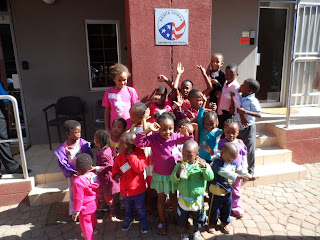 Besides being such a fun day playing with all the kids, it allowed me to see the staff from a more humanist perspective. Yes, we are all a family here - staff and PCVs - but it becomes a more powerful connection when you open up and see these more intimate moments. Knowing that I'm going to be working so closely with them in the upcoming year, I feel this was the perfect opportunity to share something deeper and I feel fortunate to have had the opportunity. Also, have I mentioned that I like playing with adorable kids? Because their energy and excitement over it all really makes it worthwhile. Totally.
PCI Head Start
Last week, after submitting my updated resume, one of the staff from PCI called and asked if I would be willing to attend a meeting put on by UNESCO (United Nations Educational, Scientific, and Cultural Organization) and UNDP (United Nations Development Programme). The meeting was being called to review and revise a toolkit for HIV prevention and treatment for adolescents - a facilitator's guide for trainers, a manual for teachers, and three separate workbook for adolescents (ages ranging between 10-years-old and 19-years-old). Essentially, there is a pre-existing toolkit that has been being used in South Africa, Zimbabwe, Zambia, and other Southern African nations, and they are hoping to implement something similar in Botswana. To do this, they asked a group of experts to assemble and adapt the current documents to something usable here.
The room was literally full of the best minds Botswana has to offer and some of the highest government officials. They ranged from the heads of NACA (Botswana's National AIDS Coordinating Agency), the Ministries of Education and Health, and Baylor Children's Clinic to directors of some of the key national and international NGOs dealing with adolescent health issues in the country. I felt like a very small face in this specialized crowd and wondered why I had been invited to join this meeting. I resolved to try my best to contribute and to learn as much as I could during the meeting, in the hopes of being a valuable resource in the future.
By the end of our first reading of the documents, the representatives in my group were providing me with accolades for my insights and all that I had to offer in terms of contextualizing the document for Batswana youth and for organizational structure and ease of use. It seems that my work on the ground and in the villages has provided me with keen insights often overlooked at this higher level that were extremely useful in revising the toolkit. To the point that the project head from UNESCO asked me if I would be willing to continue my revisions after the meeting because they wanted to get it finalized and begin implementation by June of this year.
All of this gave me confidence in myself and in the skills and knowledge I have developed during my time here. I was overjoyed to be in this company and to be able to contribute meaningfully to the project. I was proud of myself and grateful that PCI felt I was a worthy representative for their organization.
So here I am, with less than a month left in my two year contract, preparing and actually starting some activities for my future extension assignments. I am so content with where things are going and full of excitement about the work ahead of me. I think this is really going to be something great!
As I have mentioned before, I will have two assignments when I start my third year: one with Project Concern International (PCI) as a Technical Advisor for their Tsela Kgopo OVC and Gender Project and the other with Peace Corps as a Volunteer Leader. I will officially begin my new assignments on July 1st. But, as you likely could infer from my ramblings over the past two years, I have never been one for "going with the grain", so to speak. My natural instinct is to gather all the information available and dive head-first into whatever lies before me. This has served me well in the past so it is no surprise that I would do the same again here in Botswana with my third year assignments.

Two weeks ago, my Country Director called and asked me if I would be willing to help plan and host a "Take Your Kid To Work Day" at the Peace Corps office. My role would be to come up with the agenda and activities, coordinate volunteers, and facilitate the day. A chance to play with adorable little kids all day and call it "work"?! Of course I agreed!
In collaboration with the office's Executive Assistant, I planned the agenda for the day. We decided to make it like a real work day for the kids (aged 3- to 10-years-old). They would get "official" nametags with the Peace Corps insignia and the title "Junior Staff" presented at a mock staff meeting in the morning, where they would also take their Oath of Service alongside their parents and other staff. They would go on to receive "medical clearance", complete with watching their heartbeat on a monitor, then go through "security check", which meant learning about basic safety then learning how to use an air horn and put out a real fire with a fire extinguisher! The rest of the day required them to be "Program Support" for the different sectors their parents worked in. Activities included shredding paper (big fun for a little kid!), stamping envelopes, and making friendship bracelets and doing crafts (to help come up with fun activities for PCVs to do with kids in their villages, of course!).

PCI Head Start
Last week, after submitting my updated resume, one of the staff from PCI called and asked if I would be willing to attend a meeting put on by UNESCO (United Nations Educational, Scientific, and Cultural Organization) and UNDP (United Nations Development Programme). The meeting was being called to review and revise a toolkit for HIV prevention and treatment for adolescents - a facilitator's guide for trainers, a manual for teachers, and three separate workbook for adolescents (ages ranging between 10-years-old and 19-years-old). Essentially, there is a pre-existing toolkit that has been being used in South Africa, Zimbabwe, Zambia, and other Southern African nations, and they are hoping to implement something similar in Botswana. To do this, they asked a group of experts to assemble and adapt the current documents to something usable here.
The room was literally full of the best minds Botswana has to offer and some of the highest government officials. They ranged from the heads of NACA (Botswana's National AIDS Coordinating Agency), the Ministries of Education and Health, and Baylor Children's Clinic to directors of some of the key national and international NGOs dealing with adolescent health issues in the country. I felt like a very small face in this specialized crowd and wondered why I had been invited to join this meeting. I resolved to try my best to contribute and to learn as much as I could during the meeting, in the hopes of being a valuable resource in the future.
By the end of our first reading of the documents, the representatives in my group were providing me with accolades for my insights and all that I had to offer in terms of contextualizing the document for Batswana youth and for organizational structure and ease of use. It seems that my work on the ground and in the villages has provided me with keen insights often overlooked at this higher level that were extremely useful in revising the toolkit. To the point that the project head from UNESCO asked me if I would be willing to continue my revisions after the meeting because they wanted to get it finalized and begin implementation by June of this year.
All of this gave me confidence in myself and in the skills and knowledge I have developed during my time here. I was overjoyed to be in this company and to be able to contribute meaningfully to the project. I was proud of myself and grateful that PCI felt I was a worthy representative for their organization.
So here I am, with less than a month left in my two year contract, preparing and actually starting some activities for my future extension assignments. I am so content with where things are going and full of excitement about the work ahead of me. I think this is really going to be something great!
Tuesday, February 12, 2013
"Terrific Tuesday" Tales
I entitled this post "Terrific Tuesday Tales" because today's "tales" (i.e. updates) are terrific... and it is Tuesday. Self-explanatory, I suppose, but I felt it warranted pointing out. This is most likely because I felt a desperate need to use an alliteration but wanted to let my readers know there was a reason for it and not just because I'm a great big dork (which I am). (Don't judge me: I worked at a summer camp, I make friendship bracelets with every kid I know, and I hang out with children every day - it's practically a prerequisite to like alliterations and other goofy things!) Honestly, I called the post this because I wanted to very simply "shout out loud" that life in the village is moving ahead terrifically!
For starters, I was awoken this morning by a phone call from my Country Director. He called specifically to discuss my application for extension. He clearly stated that our post is still waiting for funding approval for future extendees from Headquarters in DC and therefore cannot officially issue offers for third year extensions to anyone yet, but that he wanted me to know that my application was very well done and that I am "a highly qualified candidate" for my proposed extension. He went on to say that discussions about placement for all volunteers who are selected will begin as soon as the funding is approved. Knowing more about the process and the stages makes a huge difference for my mental well-being as I approach our COS Conference and look towards the next year. I feel like I can breathe a big sigh of relief knowing that I will likely be continuing the great work being done in Botswana for a third year. (I hope!)
Next, an update on my house-building project. As things so often go, costs of materials have fluctuated (mostly on the upswing), which has caused some delay in purchasing the last of the pieces we need for the house. That being said, we are moving forward with the project and should only be delayed about a week. The cement has been laid for the walls and floors, the windows went in today, the doors and locks (extra heavy duty) should be purchased by Thursday and installed over the weekend, and then all we have left to do is link the pre-existing single-room structure to the newly built home. We are doing this by putting a tin roof cover between the buildings and laying concrete between them. We are also going to construct a small outdoor kitchen in this section. This is a significant improvement for the family, as they have currently been preparing all meals over an open flame outside. Also of improvement, I was able to get mattresses donated for the family. That means that each of those children will have their very own mattress in their new home. Far cry from the blankets they share curled up on the floor right now! Finally, as I mentioned before, the hole for the pit latrine has been dug out and we have purchased the bricks and cement to build the structure. We have manpower together to construct it over the weekend as well. So, barring any further delays, we are hoping the entire structure (sans electricity at this point) will be ready for "handing over" by the end of next week. Wow.
Some months back, I wrote two proposals to a local foundation. I hadn't heard much since submitting them, despite many attempts to follow up with the foundation. That is until this afternoon when my phone rang (yet again) and I answered to find a representative from the foundation on the line. She was calling to inform me that the selection team met earlier this morning to discuss the first of my proposals, which requested a combi (van-like vehicle) to transport the children and patients that are enrolled in programs at my NGO. She went on to state that, after much discussion on my center, they were awarding us our request! This means that my NGO will be getting a shiny new (BRAND NEW) combi! This will help us so much. Not only because our current combi is ancient and costs us a lot in repairs, but also because we have created an income-generating plan for our old combi. Although it has "old car" problems, it's still operational. We are hoping to rent it out for a small daily fee, renters paying for petrol and maintenance, which would be able to go back into programs and increase our sustainability. But, no, the greatness of this phone call does not end here! The foundation representative that called went on to say that a visitor I had hosted at our center spoke highly of our work and our proposal was so well done that they are going to move it to the top of their list to review at their next meeting in May. She insinuated that they already wanted to approve it! The foundation needs to clarify some of their policies on their funding but, if this does happen, my NGO stands to get operational costs, including staff salaries (everyone is unpaid and works voluntarily right now) and two additional staff positions to alleviate the burden and scale up services. Now wouldn't that be a huge leap forward for our center?!
Finally, I am helping to organize an international public service program for a distinguished businessman who contacted me specifically because of the work I have done and asked for my assistance. Although I can't get into the specifics quite yet, the program will be aimed at educating people on grassroots development and hands-on service and hopefully create a global environment for giving back. Stay tuned, especially other PCVs because I may be calling you to host a small gathering or talk at your organizations to discuss the work you and your centers do!
In the words of my NGO's coordinator... "We just have to sing and dance and make a joyful noise!" Today's been a good day!
For starters, I was awoken this morning by a phone call from my Country Director. He called specifically to discuss my application for extension. He clearly stated that our post is still waiting for funding approval for future extendees from Headquarters in DC and therefore cannot officially issue offers for third year extensions to anyone yet, but that he wanted me to know that my application was very well done and that I am "a highly qualified candidate" for my proposed extension. He went on to say that discussions about placement for all volunteers who are selected will begin as soon as the funding is approved. Knowing more about the process and the stages makes a huge difference for my mental well-being as I approach our COS Conference and look towards the next year. I feel like I can breathe a big sigh of relief knowing that I will likely be continuing the great work being done in Botswana for a third year. (I hope!)
Next, an update on my house-building project. As things so often go, costs of materials have fluctuated (mostly on the upswing), which has caused some delay in purchasing the last of the pieces we need for the house. That being said, we are moving forward with the project and should only be delayed about a week. The cement has been laid for the walls and floors, the windows went in today, the doors and locks (extra heavy duty) should be purchased by Thursday and installed over the weekend, and then all we have left to do is link the pre-existing single-room structure to the newly built home. We are doing this by putting a tin roof cover between the buildings and laying concrete between them. We are also going to construct a small outdoor kitchen in this section. This is a significant improvement for the family, as they have currently been preparing all meals over an open flame outside. Also of improvement, I was able to get mattresses donated for the family. That means that each of those children will have their very own mattress in their new home. Far cry from the blankets they share curled up on the floor right now! Finally, as I mentioned before, the hole for the pit latrine has been dug out and we have purchased the bricks and cement to build the structure. We have manpower together to construct it over the weekend as well. So, barring any further delays, we are hoping the entire structure (sans electricity at this point) will be ready for "handing over" by the end of next week. Wow.
Some months back, I wrote two proposals to a local foundation. I hadn't heard much since submitting them, despite many attempts to follow up with the foundation. That is until this afternoon when my phone rang (yet again) and I answered to find a representative from the foundation on the line. She was calling to inform me that the selection team met earlier this morning to discuss the first of my proposals, which requested a combi (van-like vehicle) to transport the children and patients that are enrolled in programs at my NGO. She went on to state that, after much discussion on my center, they were awarding us our request! This means that my NGO will be getting a shiny new (BRAND NEW) combi! This will help us so much. Not only because our current combi is ancient and costs us a lot in repairs, but also because we have created an income-generating plan for our old combi. Although it has "old car" problems, it's still operational. We are hoping to rent it out for a small daily fee, renters paying for petrol and maintenance, which would be able to go back into programs and increase our sustainability. But, no, the greatness of this phone call does not end here! The foundation representative that called went on to say that a visitor I had hosted at our center spoke highly of our work and our proposal was so well done that they are going to move it to the top of their list to review at their next meeting in May. She insinuated that they already wanted to approve it! The foundation needs to clarify some of their policies on their funding but, if this does happen, my NGO stands to get operational costs, including staff salaries (everyone is unpaid and works voluntarily right now) and two additional staff positions to alleviate the burden and scale up services. Now wouldn't that be a huge leap forward for our center?!
Finally, I am helping to organize an international public service program for a distinguished businessman who contacted me specifically because of the work I have done and asked for my assistance. Although I can't get into the specifics quite yet, the program will be aimed at educating people on grassroots development and hands-on service and hopefully create a global environment for giving back. Stay tuned, especially other PCVs because I may be calling you to host a small gathering or talk at your organizations to discuss the work you and your centers do!
In the words of my NGO's coordinator... "We just have to sing and dance and make a joyful noise!" Today's been a good day!
Wednesday, January 30, 2013
Capacity Building Gone Right!
The whole point of capacity building is to transfer skills to others so they can do their jobs better and, in the case of NGOs like mine, scale up their systems and better serve their constituents. So, if you have "students" that are actively trying to learn and you are a dedicated "teacher", doing the job well should mean you are no longer needed. After all, if they learned the skills and can use them properly, then your constant presence is unnecessary. That is the goal.
True capacity building is terribly difficult and, often times, Peace Corps Volunteers feel like they are constantly hitting their heads against a wall. Basically, you're asking people to do things above and beyond their preexisting work and they often don't see the rationale or what benefits might come in working extra hard for a while. Plainly, "if it ain't broke, don't fix it." And our response to them is that, "just because they can't see the cracks, doesn't mean they don't exist". Try convincing someone to follow you with answers like that! It's TOUGH!
I decided early on in my service that I was going to be steadfast to Peace Corps' approach to development: "helping people develop the capacity to improve their own lives". This meant focusing on the development of people and not things. And it also meant that I wasn't going to do things on my own just because it would be easier (and much faster) that way. I was going to take the long road and do everything step-by-step with the people that I work with to ensure they learned what they were doing. Even if that meant spending hours going over and over and over the same things and taking the time to hand-write instruction manuals for even the simplest of tasks. (Yes, I even put a "ON/OFF" sticker on the power button on the computer and everything moved forward from there...)
I have had relative success in capacity building at my NGO, mostly in terms of systems strengthening. I think that is due, at least in part, to the fact that I have been patient in explaining things to the staff and have demanded they participate in every single thing that I do there. They are learning the skills to do everything from typing to drafting reports to financial management and administration and they are gaining the confidence in themselves to carry out their tasks. (I make a big fuss over them when they remember how to "align right" or enter something into QuickBooks. They laugh and cheer themselves on and feel proud of themselves for their accomplishments. In turn, I believe it also inspires them to keep trying.)
Just this week, there have been a number of huge examples of the success of capacity building at the center. I am like a "proud mom" because I can see how much all of our hard work (theirs and mine) is paying off. So here we go:
True capacity building is terribly difficult and, often times, Peace Corps Volunteers feel like they are constantly hitting their heads against a wall. Basically, you're asking people to do things above and beyond their preexisting work and they often don't see the rationale or what benefits might come in working extra hard for a while. Plainly, "if it ain't broke, don't fix it." And our response to them is that, "just because they can't see the cracks, doesn't mean they don't exist". Try convincing someone to follow you with answers like that! It's TOUGH!
I decided early on in my service that I was going to be steadfast to Peace Corps' approach to development: "helping people develop the capacity to improve their own lives". This meant focusing on the development of people and not things. And it also meant that I wasn't going to do things on my own just because it would be easier (and much faster) that way. I was going to take the long road and do everything step-by-step with the people that I work with to ensure they learned what they were doing. Even if that meant spending hours going over and over and over the same things and taking the time to hand-write instruction manuals for even the simplest of tasks. (Yes, I even put a "ON/OFF" sticker on the power button on the computer and everything moved forward from there...)
I have had relative success in capacity building at my NGO, mostly in terms of systems strengthening. I think that is due, at least in part, to the fact that I have been patient in explaining things to the staff and have demanded they participate in every single thing that I do there. They are learning the skills to do everything from typing to drafting reports to financial management and administration and they are gaining the confidence in themselves to carry out their tasks. (I make a big fuss over them when they remember how to "align right" or enter something into QuickBooks. They laugh and cheer themselves on and feel proud of themselves for their accomplishments. In turn, I believe it also inspires them to keep trying.)
Just this week, there have been a number of huge examples of the success of capacity building at the center. I am like a "proud mom" because I can see how much all of our hard work (theirs and mine) is paying off. So here we go:
The ladies at the NGO successfully put together their very first financial report. This meant going through an entire year's worth of receipts and bank statements, organizing them by category and entering them into the computer, tabulating results, and building charts.
The center had its very first Annual Meeting where the staff presented their very first Annual Report. Although I helped with the report, the ladies presented it on their own and fielded all of the questions from the Executive and General Committees. (We spent days prepping for every possible question and brainstorming solutions. The ladies took the initiative on this end and even worked extra hours to get ready.)
The Administrative Officer at the center installed the ink into our new printer, typed up multiple letters, and printed them off all on her own. I wasn't even present for any of these actions. This may not seem like a huge deal but, less than a year ago, she couldn't even turn on a computer.
They have learned the definition of "promptness" and are using it in their lives. This is no small feat. "African time" is very real and has been a frustration of mine throughout my service. Today, when I told the ladies I would be at the center "around 8am", which in the past would have allowed me to stroll in any time up until 10am, garnered me a phone call at 8:01 because I wasn't there yet and they were ready and waiting to get started on projects.
When I first arrived at the NGO in February 2012, I recognized a need for better communication among the staff. I started bringing the staff together for meetings. It was a time, I explained, to share about projects, successes, and problems; to brainstorm; to discuss policy changes; and so on. I was informed by the Center Coordinator today that she had called for a staff meeting. She apologized because it would be during a time when I was scheduled to be at one of the schools but assured me that she could facilitate it on her own. She then handed me a typed agenda for the meeting. I scanned the agenda and asked her if she felt confident in bringing up and explaining some of the policy changes she was calling for. She said that she was because she understood the reasons for them and was sure that she could tell the staff in such a way that they would understand as well.Whoa! What a week worth of successes! Now that's capacity building gone right! It's such an awesome thing to see your need slowly start to fade away... And it definitely makes it easier looking ahead to leaving. It's a relief and such an amazing feeling to finally feel like they are getting it! :-D
Thursday, January 24, 2013
Quick Update: Pit Latrine DUG!
I wanted to give a very quick update on the House Building Project, mostly because there is progress! As of this afternoon, the hole for the pit latrine has been dug out! YAY! That's a huge process and absolutely vital for the success of a pit latrine. (I mean, imagine if you didn't have the super deep hole for the poo to go?!) The bricks for the structure are being delivered over the weekend and the entire pit latrine should be constructed by next week! Double YAY! And then this family will finally be able to go to the bathroom on their own compound and in an actual toilet. I am so beside myself with excitement right now. This is another huge success for this Peace Corps Volunteer!
Gardening success!!!
If you have been following along, you will know that my NGO's garden was tripled in size in October as a result of a partnerships with the Office of the President. There was a big event, complete with speeches, presentations of donations, a massive community service day, and attendance by His Excellency Seretse Khama Ian Khama and his entire cabinet. It was absolutely remarkable. And I am here today to let all the good people out there know that the efforts made on that day were not in vain.
 Today, ladies and gentlemen, Gabane Home-Based Care sold its very first stock of vegetables to the community! In fact, we produced so many vegetables that we were able to feed our children, provide our most needy patients with food, and still have enough left over to put up a stand down by the combi rank to sell an abundance of extras. Not only that, but after cleaning all the vegetables and preparing them for sale, we added up how much we stand to make. I won't get into exact figures but our profits should be enough to buy all new seeds to re-plant, some saplings to continue planting our fruit tree orchard, and still have money left over to put back into our programs! Now if that's not a success then I don't know what is! Hooray!

Monday, January 14, 2013
House Building Project Update
Last week we finalized the paperwork to move forward with the house building project. This meant meeting with the Kgosi to authorize (and ensure) inheritance of the plot and its structures to the children and grandchildren when the mother eventually passes and then submitting the forms with the land board. This was of utmost importance to me before continuing the construction, primarily because I want to make sure the young ones do not get overpowered by long lost relatives or anyone else who might sweep in during the 11th hour and leave the kids even more destitute. Fortunately, we were successful in getting everything organized and officially filed so it was all systems go on the project over the weekend!
The interior of the house has been plastered and the doors have been ordered. Painting and installation of windows, doors, and so forth is set for some time within the next two weeks. If our financial resources hold out, it looks like we will also be able to get the house wired for electricity. In total, the house should be ready for the family to be moved in by Valentine's Day! Now that's what I call a "gift of love"!
This is a collosal achievement - building a home for this family will improve their lives beyond measure. This is possible because of the kind, generous, and wonderful support of the Gabane and American communities who have pledged so much. I will forever be grateful to each person who shared in this project.
The interior of the house has been plastered and the doors have been ordered. Painting and installation of windows, doors, and so forth is set for some time within the next two weeks. If our financial resources hold out, it looks like we will also be able to get the house wired for electricity. In total, the house should be ready for the family to be moved in by Valentine's Day! Now that's what I call a "gift of love"!
This is a collosal achievement - building a home for this family will improve their lives beyond measure. This is possible because of the kind, generous, and wonderful support of the Gabane and American communities who have pledged so much. I will forever be grateful to each person who shared in this project.
Sunday, November 18, 2012
House Building Project
Many months ago, I wrote about an extremely destitute family that my NGO works with through its home-based care program. The matriarch of the family is HIV+ and her health has deteriorated to a level where she is now bed-bound and unable to do basic tasks for herself (like get up to relieve herself). She has six young children living with her and no one in the home to assist with child-rearing (i.e. the father has passed and there is no known family otherwise). There are also two teenaged daughters, unfortunately both have now died of HIV in the months since I have known them. One of the daughters left an infant baby to, essentially, be reared by her younger siblings, making seven children in total living in the home.
In my posts about this family, you may also remember that I said this family is living in a one-room house without water or electricity (in the house or on the compound). The family curls up together day-in and day-out, with the mother sleeping on the only bed that fits inside the home. The other children pile onto blankets on the floor and the infant baby sleeps next to the sick mother. Food is scarce. The family is endowed with a support check from the government in the total of P150 per month (US$21) that they use to buy food. This is not enough but they make due with the supplemental food my NGO is able to give them through our feeding program. This, much to our dismay, is nominal as well but every bit helps. Finally, the family also doesn't have a toilet or a pit latrine on their compound so they defecate into a bucket and bring it to the neighbor's house to dispose of it. This is a hard process, especially for a sick mother whose children are attempting to stay in school, rear themselves, and care for the family simultaneously. This family is, far and away, the hardest situation and most impoverished that I have encountered since coming here. Theirs is a life of hardship to say the least.
A project that I have taken on has been to help build the family a home. I am proud to say that, to date, we have completed the foundation, built support for the walls, and put a ceiling on the basic structure. All of this has been done with donations of time, money, and materials by community members that have recognized the desperate need. We are in the final push right now to mobilize resources and are engaging in a fundraising campaign with a number of individuals and communities. As the days pass, it looks more and more promising that we will raise the necessary funds to finish this house and give the family a home to call their own.
A quick note on the toilet situation because it is a necessary side-project of the "house building project" and is something we all feel is very important (as hygiene plays a significant role in health), and therefore something we have been working diligently on. I am pleased to say that we believe this project will also come to fruition in the upcoming months. I have been working with a Church group in Botswana that has been spearheading the fundraising effort to dig a pit latrine on the compound. They are hopeful that the funding will come through by the end of the year and that we can start digging in the first months of 2013. This will make a huge difference for the family and I am exceedingly grateful for their continued efforts.
I am beside myself with appreciation for the love and support of so many communities in making this project a reality. If you are reading this and have participated in this project on some level, please know the depth of my gratitute - I will never forget your kindness and generosity and neither will the family. This house will belong to these children when they truly become orphaned. They will not be homeless and they will have something to call their own. And, until that day, they will have a safe place to live. This will relieve their stress and their burden and, I believe, bring them comfort both in actuality and in knowing that so many people care about them and their well-being.
In my posts about this family, you may also remember that I said this family is living in a one-room house without water or electricity (in the house or on the compound). The family curls up together day-in and day-out, with the mother sleeping on the only bed that fits inside the home. The other children pile onto blankets on the floor and the infant baby sleeps next to the sick mother. Food is scarce. The family is endowed with a support check from the government in the total of P150 per month (US$21) that they use to buy food. This is not enough but they make due with the supplemental food my NGO is able to give them through our feeding program. This, much to our dismay, is nominal as well but every bit helps. Finally, the family also doesn't have a toilet or a pit latrine on their compound so they defecate into a bucket and bring it to the neighbor's house to dispose of it. This is a hard process, especially for a sick mother whose children are attempting to stay in school, rear themselves, and care for the family simultaneously. This family is, far and away, the hardest situation and most impoverished that I have encountered since coming here. Theirs is a life of hardship to say the least.
A project that I have taken on has been to help build the family a home. I am proud to say that, to date, we have completed the foundation, built support for the walls, and put a ceiling on the basic structure. All of this has been done with donations of time, money, and materials by community members that have recognized the desperate need. We are in the final push right now to mobilize resources and are engaging in a fundraising campaign with a number of individuals and communities. As the days pass, it looks more and more promising that we will raise the necessary funds to finish this house and give the family a home to call their own.
A quick note on the toilet situation because it is a necessary side-project of the "house building project" and is something we all feel is very important (as hygiene plays a significant role in health), and therefore something we have been working diligently on. I am pleased to say that we believe this project will also come to fruition in the upcoming months. I have been working with a Church group in Botswana that has been spearheading the fundraising effort to dig a pit latrine on the compound. They are hopeful that the funding will come through by the end of the year and that we can start digging in the first months of 2013. This will make a huge difference for the family and I am exceedingly grateful for their continued efforts.
I am beside myself with appreciation for the love and support of so many communities in making this project a reality. If you are reading this and have participated in this project on some level, please know the depth of my gratitute - I will never forget your kindness and generosity and neither will the family. This house will belong to these children when they truly become orphaned. They will not be homeless and they will have something to call their own. And, until that day, they will have a safe place to live. This will relieve their stress and their burden and, I believe, bring them comfort both in actuality and in knowing that so many people care about them and their well-being.
Monday, November 5, 2012
How To Build Community
An old friend of mine posted this on Facebook the other day. It speaks perfectly to what being a Peace Corps Volunteer is all about. And, I believe, states the basic principles that we all should live by.


Tuesday, October 23, 2012
Continued Excitement and Success
Today has been another extraordinary day for me and for Gabane Community Home-Based Care for two reasons:
1. This morning we had a meeting with a representative from a national foundation that wants to fund all of our operational costs for the center for the next two to three years! She said they have only accepted proposals to fund operational costs twice in the foundation's history but that, after seeing our organization and talking with us, she will be our personal advocate to make sure our proposal goes through. We will learn the final decision in two weeks but she thinks it will happen.
2. Our dilapidated old playground is going to be replaced! Why? Because I have organized to get a new one donated to our center! In the upcoming months, the old playground will be renovated and a new playground added to our existing one. That's twice the fun for our little ones!
My NGO has certainly received its fair share of blessings lately. We couldn't be more grateful. I think this sort of achievement calls for a "Percy Happy Dance"!
1. This morning we had a meeting with a representative from a national foundation that wants to fund all of our operational costs for the center for the next two to three years! She said they have only accepted proposals to fund operational costs twice in the foundation's history but that, after seeing our organization and talking with us, she will be our personal advocate to make sure our proposal goes through. We will learn the final decision in two weeks but she thinks it will happen.
2. Our dilapidated old playground is going to be replaced! Why? Because I have organized to get a new one donated to our center! In the upcoming months, the old playground will be renovated and a new playground added to our existing one. That's twice the fun for our little ones!
My NGO has certainly received its fair share of blessings lately. We couldn't be more grateful. I think this sort of achievement calls for a "Percy Happy Dance"!
Subscribe to:
Posts (Atom)