For nearly a year, I have been working as part of a technical team to develop a resource pack to train educators and communities about integrated early childhood development (IECD). In my final days working at PCI, we finished the IECD Resource Pack and received approval from the Government of Botswana for it to be used as part of a curriculum to certify pre-school teachers from rural and remote communities. This was a huge feat for us and something we were very proud to achieve because of its potential positive impact for these most at-risk communities.
This week we started our very first training using the IECD Resource Pack. My counterpart in the effort called me to thank me for all of the great work I did and to let me know that the training was going exceedingly well and she was so happy. Yesterday, the US Embassy in Botswana posted about this training (and, subsequently, my resource pack) on their Facebook page. It is wonderful that our project is getting accolades and visibility in this way. I am so proud to have been a key player in this project and am excited to see where it goes from here.
Showing posts with label PCI. Show all posts
Thursday, June 19, 2014
Sunday, March 9, 2014
Published: A Toolkit For Better Life Skills Education
Behold! The very first printed draft of the Adolescent Life Skills Toolkit I put together!
After meeting last week with relevant heads of all Botswana's Ministries and other pertinent stakeholders, it has been confirmed that the final draft of my toolkit will be adopted by the Botswana Government and used to strengthen the country's current national strategy for life skills education! Booyah! Now that's a Peace Corps win!
Friday, March 7, 2014
IECD and LS Technical Working Retreat
Much of my work at PCI has been focused on integrated early childhood development (IECD) and life skills (LS). I have been working very hard to improve the lives of young children and adolescents in Botswana by creating better systems and resources and enhancing the access to and understanding of programs for the most rural and vulnerable communities. As part of this effort, I have conducted focus groups on effective facilitation of LS material (LS topics include communication, self-esteem and awareness, critical thinking, and so on), lead workshops for single teenage mothers, met with stakeholders and partners from across the country, providing technical assistance to civil society organizations working in these areas, and drafted and compiled concept notes and resource books set for publication on both IECD and LS.
This last project is of particular note because it was a catalyst for a workshop eleven years in the making. Yes, eleven.
In 2003, the Botswana Government partnered with UNICEF to analyze the IECD and LS programs. They found both to be lacking and called for a technical team to be constructed and a way forward agreed upon. To date, nothing of substance has been done to address this mandate. They have, however, created "frameworks", which essentially are merely outlines, of what the desired outcomes would be for IECD and LS programs for children and adolescents. There were many MANY gaps left to be filled in and the right players had not stepped up to the plate.
Our week-long "technical working retreat", as we called it, brought heads of Government Ministries and stakeholders together to accomplish a handful of very important objectives. Of note: finally addressing the challenges and gaps with IECD and LS in Botswana; determining who is responsible for various components of these programs; reviewing the documents PCI and I proposed (which should act as the "filler" for the frameworks); and making technical, policy, and advocacy recommendations for national program revisions. We wanted people to understand what was going on, to take ownership over the situation and their roles, and to create a plan for what our ideal "model" would be for IECD and LS. This was an invariable who's who of leaders in their fields and they were poised and ready to tackle these hard issues. After eleven years of waiting, we made it happen.
Without going into too much detail about the five days (for fear of boring you with jargon and nitty gritty), I want to say that the retreat was an overwhelming success. The background was given, the studies were read, and a greater understanding was reached. The people became instantly motivated to make a change. We were able to have the conversations with all the right parties present and really hash out the intricacies of what works, what doesn't, and what we would like to see in IECD and LS education, especially for those most marginalized populations. And we did it in front of each other, meaning there should be accountability as we move forward. Basically, the environment was right. We now have task forces set up to deal with smaller issues and we have a larger plan for tackling the entire project. We are on the same page.
In the months before I close my service and finish my time with PCI, I will be packaging the ideas for our model program into something that can be discussed, marketed, and implemented, as well as meeting with all of the task forces to monitor their progress in addressing the key issues agreed upon at the retreat and finalizing the documents I have been working on and beginning to train partners and stakeholders on how to use them. There is still so much to be done but we are on the right track.
And what a beautiful place to be doing this all in...
Tuesday, February 11, 2014
Young Single Mothers Workshop
We all too often take for granted things that shape who we are. Things like upbringing, presence of supportive caregivers and adults, nutrition, and friends. But what if these things didn't exist in our lives? Or if they were offered in fragments and then taken away from you? What if you were an orphan and raised yourself? There are lessons learned in life that naturally happen in so many of our homes and schools that we don't even recognize. What happens when people don't learn how to communicate effectively or care for their basic needs? I am now much more conscious of that reality, as it is the basis for much of the work I have been doing in the past months. This has given me the opportunity to delve deeper into the issues facing the youth of Botswana, in particular, young women.
Twenty-three young single mothers turned up for the two-day workshop run by one of our implementing partners in a nearby village. I was invited to attend to support the partner and assist in facilitating sessions on self-awareness, self-esteem, and communication. I was joined by two other members of the PCI team and some nurses from the local clinic, who were scheduled to discuss sexual reproductive health and topics on caring for young children.
The workshop was designed to be participatory, encouraging the young women to search for their own solutions and to create a sense of community among those in similar circumstance. As such, activities were collaborative, involving a lot of group work and discussions, and the women were challenged to work through differences in order to create viable options for their collective future. This meant focusing on problem solving, planning, and critical thinking - all of which are often neglected in a country that prides its education system on rote memorization.
Overcoming the challenges of the workshop model was met first with argument and then, in time, with laughter. The latter lead to dialogue that brought great results and the girls began to prosper. It wasn't long before the women were opening up and starting to acknowledge some of their commonalities (something we believe will unite them and give them strength). It was empowering to witness.
In the end, the women made great strides in both their approach to examining and addressing issues, as well as in creating a team among one another. They were able to learn from one another and, thereby teaching them lessons long deprived. What's more, the partner organization gained the experience in facilitating a workshop of this nature and have vowed to follow the women and support them as they work towards implementing some of the activities they decided, as a team, to go for. They are no longer orphans, alone, trying to overcome hardship and raise children. They are together.
This is the sort of sustainable development that we always hope for - the kind where people learn how to help themselves and local organizations gain the skills necessary to support those efforts. I am going to be mentoring this organization for the final months of my contract but I am confident in their ability to continue in this manner. I am just proud to be there to witness it.
"Be content with what you have; rejoice in the way things are.
When you realize there is nothing lacking, the whole world belongs to you."
Wednesday, February 5, 2014
“There is some good in this world, and it's worth fighting for.”
Even among employees and organizations that are qualified, passionate, and maintain strong values, apathy and atrophy tend to set in from time-to-time. It is a disheartening truth that impacts the quality and amount of work that is able to be done. Sometimes, when these infect a single (but key) person, the ripple effect can be great. These negative attributes, then, can lead to an under-utilization of motivated human resources or a withdrawal of those resources altogether. This is the reality I have been facing.
I have spent the last few months as a stunted version of myself. I have felt somewhat ineffectual in carrying out significant meaningful work within my primary assignment and have struggled to find a way to make a contribution within the confines outlined to me. Simply, I didn't have the freedom to create the change I wanted - and have become accustomed to - and I saw myself falling into professional doldrums.
That is not to say I have been stagnant. Besides my work for Peace Corps (as a Volunteer Leader), I have, in fact, been working on a couple large scale projects that stand to be extremely influential in the future. These include a Life Skills Toolkit and an IECD Resource Pack, both to be published and adopted by the Government of Botswana to strengthen its current National Strategies. Unfortunately, despite my dedication to these efforts, my work was constantly being put on hold in favor of, what seemed to be, waiting around for others to get motivated and involved enough to sign off on my (finished) work. This has caused me great frustration. I hold myself to a certain standard of giving back and helping others and have dedicated myself to that. Not being able to achieve to my full potential is a difficult pill to swallow, especially when you want it so badly.
Something had to be done. And now.
So I had a few conversations - conversations with colleagues that led to conversations with my superiors at Peace Corps that culminated in some very staunch heart-to-hearts with my counterparts and supervisors at my primary assignment. While the conversations were difficult, I am optimistic that positive change is on the way. Why am I so optimistic? Because I am no longer directly tethered to others within my agency so what happens next is up to me.
I am now taking over and managing a number of fairly high profile national projects and have been granted independence to build capacity of implementing partners across the country. This means I can go out in a technical capacity and work directly with the providers in the field to help them integrate and actualize programming, as well as strengthen systems and organizational capacity in order to improve service delivery. Working directly with the implementing partners is a resource and valuable experience both for me and for the organizations I now have the authority to work with. And the quality and level of my involvement is mine alone to determine, with the support of my counterpart, her supervisor, and the agency as a whole. Hallelujah! I am finally free to start making an impact in a much more meaningful way again! Good news all around!
Wednesday, October 9, 2013
Progress: Life Skills Toolkit
Today I put the finishing touches on the nearly 300-page Life Skills Toolkit that I have been working on for the past few months. It is still in draft form but I would say that it is now at the "final rough draft" stage. And I am pretty happy with that!
A lot goes into a document of this magnitude - one intended for publication and dissemination on a national level - so getting to this point has been no small feat. It has required significant research, focus groups, discussions, and analysis. All before organizing lesson plans and more into one cohesive document. I am proud to say that my compilation skills seem to be top notch and the information contained in those pages should be highly beneficial for life skills facilitators. Or at least I hope so.
To ensure the material is at the standard it needs to be, we are in the process of assembling a technical team to review and provide feedback on the document. We are calling on the heads of Botswana's Ministries, leaders in the education field, teachers, and even a few acclaimed students. I will sit with them throughout this process, gathering information, and having a dialogue about content. Afterwards, it's back to the keyboard and long hours to get it finished by mid-November, just in time to go to print before the nearly month-long festive holiday. Phew.
The more I work on this project, the more I understand the great need for it. With each teacher and volunteer and student that I talk to, I become more dedicated to its cause and excited to be a key player in making it happen. Because, while Botswana does have a great framework for life skills education and a basic curriculum, nothing exists with information for implementation. This toolkit should act as a way forward in using the preexisting material. Botswana needs something like this and the children and youth deserve it. Life skills education, here we come!
Thursday, September 5, 2013
Educating Towards A Better Tomorrow
In 2006, Botswana's Ministry of Education and Skills Development (MoESD) set about developing a National Life Skills Framework that would guide the creation and implementation of the Life Skills program. The underlying belief inherent in this program is that children are the most important national resources and that they will become the leaders of tomorrow. The Life Skills program, therefore, aims to help children develop the knowledge, attitudes, and skills necessary to avoid risky behaviors, overcome challenges, and live positive and health lives. What they developed was a strong framework that outlines learning outcomes and indicators in a number of subject areas that are meant to guide the Life Skills curriculum. What they did not create was a guideline for how to teach the material. This is where I come in.
In my role with PCI, I am entrusted with putting together a Life Skills Toolkit. The vision for the project is to create a guidebook to assist life skills facilitators with imparting knowledge onto learners by providing them with clear information and, essentially, a packet of hands-on activities and lesson plans aligned to the framework. It is the hope of PCI that this toolkit will enhance the Life Skills program and make it even more effective. As such, they intend to publish it and roll it out on a national level. This is a huge project to be involved with.
As such, I have been conducting focus groups with Batswana and have called on the experience of my colleagues who have been working within the youth development sector in Botswana - they are the experts in the field and can offer insight into best practices within the Life Skills program. It is my belief that the most rich product will be one that incorporates real-world experience with technical theory.
I am happy to report that development of the toolkit is moving along smoothly and we already have 170 pages stocked with descriptions of topics and key terms, as well as lesson plans on topics ranging from how to effectively facilitate sessions for children and young adults to compulsory content like: sexual and reproductive health, STIs, and HIV/AIDS; life skills (communication, critical thinking, goal setting, decision making, managing stress/grief/pressures, etc); values; health and safety; human rights; and finally how to monitor and evaluate your program. By November, the toolkit should be ready to go to print and hopefully there will be a national campaign by the first of the new year.
Here's hoping that 2014 brings about a more complete Life Skills program as a result of this project.
Friday, July 26, 2013
In The Field: Single Teen Mothers Workshop Series
Last week, PCI was asked to go to a small settlement called Olifants Drift to conduct a workshop for single teen mothers. The workshop was in response to the high rates of teen pregnancies, including a 12-year-old "falling pregnant" and a 14-year-old who had recently murdered her infant baby. In settlement communities like this one, where opportunities are few, this is a fairly common occurrence.
When PCI asked me to attend and help facilitate the workshop, I was overwhelmed and excited for the invitation. It would be my first official activity since starting with them and it would be my first workshop addressing this topic. We planned to discuss challenges of rural living and then train the teen moms on long-term planning (and the value of education), critical thinking, healthy relationships, risk reduction, and women's empowerment.
Seventeen single teenage mothers were in attendance. Their giggles and coy eye glances gave away the fact that they were nervous to be there. Introductions told me that the average age of the girls was eighteen and their highest schooling was the American equivalent of seventh grade. Most were mothers of more than one child.
As they warmed up to us (myself and the two other staff facilitators from PCI), they told us of their struggles - about being tricked into sex, about their perception of gender roles, about poor rainfall leading to few crops and less food, about the men who promised to marry them and feed them and care for them before running to the next girl, about the difficulties getting to villages with schools to continue their education, and about a mine coming into a nearby village (potentially creating even more problems). In between stories, they made jokes to cut the tension of the subject. They were coping the best they knew how.
After some time, the team of facilitators began working through the challenges one by one. Our team, made up of the Education and Gender Advisors, were a dynamic duo and the girls were soaking up the information. They were engaged in role playing and dialogue, utilizing PCI's GROW Model, which is geared at empowering them and helping them see their own value and strength.
One of the activities the facilitators had the girls do was to tell the room the one thing in their life they wished they could have. Saying it aloud was a form of personal commitment but also a way for their small community of teen moms to help each other achieve it. Almost all of the girls wanted to go back and finish school. Together they discussed the realities of that dream and how to make it happen. The girls seemed to be getting the information and were excited about the potential for the futures.
The two hours each way in the car through almost impassable earthen roads and the ten hour workshop seemed extremely valuable. If we could only reach a few of those girls, it would be worth it.
On our way out of the village, we watched as some of the girls rushed home to be with their children while others made their way to the local shebeen for a drink and to see what "their men" were up to. Behavior change takes time.
The one-day workshop will not be enough on its own. But at least someone had started the ball rolling - someone had taken the time to show they care about them and believe in them and want them to live better and more fulfilled lives. That was PCI, that was me, and that was the community who called to bring us there. In time maybe they will see it too. It requires a commitment from those girls and the support of the community. PCI has committed to doing more of these workshops to drive home the information and to empower these girls. I cannot wait to see it happen.
Thursday, July 25, 2013
My New Roles: Third Year Begins
My last few weeks have been jam-packed as I moved into my new apartment in Gaborone, said goodbye to a dear friend, mourned a loss, settled in, and officially began working at my third year assignments. Needless to say, there has been a lot of adjustment - something that I have gotten used to in my time abroad. Through it all, I maintain that the best things in life are seized out of moments like this - when there is an air of uncertainty coupled with a sense of adventure and an open mind. Change, vulnerability, adjustment, and opportunity are the lifeblood of a Peace Corps Volunteer.
So far, the adjustments to my new assignments - as a Volunteer Leader for Peace Corps and a Technical Advisor for PCI - have been positive. The orientations went smoothly, I have remained very excited about the work, I already feel a deep sense of purpose, and the teams I will be assisting are among the best I have known.
With PCI, I will be working with a very diverse and multicultural group of people, hailing from the far corners of the globe. Their experience is just as varied, which offers me ample opportunity to learn and grow. Similarly, the components of the $16.7 million project that PCI has me working on are just as multifarious, ranging from behavior change to economic empowerment to orphan care to integrated early childhood education and finally to women's empowerment. These facets are intertwined, thereby offering me a chance to work alongside specialists and implementing partners in all areas of the project.
While the opportunities for professional growth and exposure to various topics are plenty, there is also much more clarity in my exact role with PCI. I will be advising particularly on the integrated early childhood education (IECD) component and helping mainstream gender (which the project incorporates into all areas). My exact deliverables go as follows:
- Draft and finalize an Adolescent Life Skills Toolkit. This toolkit will be adopted as part of Botswana's National Strategy for life skills education. In this vein, I will also develop a training plan to introduce this toolkit to partners, stakeholders, and government.
- Finalize an IECD Resource Pack and develop a training plan to launch it. This includes researching and writing resource modules and rolling out trainings on the resource pack to PCI partners and stakeholders.
- Provide technical assistance to setting up an "IECD Model Site" at a village outside the capital to demonstrate best practices. This is from concept to national expansion.
- Plan and organize an IECD Forum to be attended by Botswana Government, USAID, and other key national and international agencies.
- Assist with monitoring and evaluation and reporting of the implementation of the IECD project component according to USAID's indicators. This includes conducting field monitoring activities and compiling M&E reports.
This role has me pushing myself to a higher level. It will be both challenging and immensely rewarding. And, if I am able to satisfactorily pull it all off within my one year's time, be an exceptional feat! Regardless, I am thrilled about the learning opportunity and what I stand to gain from it all. I mean, how many people can say they published two nationally-adopted manuals and created a model site from scratch?! I hope to be among those who can...
My role with Peace Corps is every bit as elaborate and will have me keeping extra busy - and, yes, it may actually feel like having two full-time jobs. It spans an array of duties, including providing technical assistance and information to volunteers, assisting staff with site development and conflict mediation, giving feedback on post and volunteer assignments, and so on.
To date, I have been being a mentor to the incoming group of Peace Corps Trainees who will be coming in two short weeks. This means hosting conference calls to discuss various topics (home stay, safety and security, packing, etc) and responding to countless emails as they prepare to come to Botswana. It has been fun getting to know them prior to arrival and makes me even more excited to meet them and participate in their upcoming training. I have also started helping with site development for the incoming group - attending community meetings to assess buy-in of the village, meeting with potential host agencies, and talking with Peace Corps staff about sites. My involvement has been minimal so far but even getting a taste of what's to come has been compelling. All in all, I think the role as a PCVL will offer extremely valuable insight into the oversight and running of a field office.
That is my third year, in brief. Or at least how it looks today.
My professional career to date has been varied. I have found the utmost satisfaction doing hands-on capacity building, as with the grassroots development work of my last two years. It will be interesting to see how this new path will feel. Will it be rewarding? Will I like this hybrid office-field assignment? Does it feel different working in an office setting now that I see the direct results in the field? Will this change the course of my future? I will keep you all apprised of my evolution and my impression of the work. I can say that I am most confident and excited about what lays before me. And I am certain that it will be a rewarding, challenging, and eye-opening year.
Labels:
Extension,
Insights,
PCI,
PCVL,
Self-Discovery,
Training,
Year Three
Saturday, April 27, 2013
Getting a Head Start: Third Year Assignments
Third year assignments typically start after a PCV finishes their work at site and reaches their original COS date. For many extendees (myself included), this also means they usually take their month-long "special home leave" before starting their new assignment. This allows for significant closure to be reached in their projects before beginning something new (and sometimes wholly different).
As I have mentioned before, I will have two assignments when I start my third year: one with Project Concern International (PCI) as a Technical Advisor for their Tsela Kgopo OVC and Gender Project and the other with Peace Corps as a Volunteer Leader. I will officially begin my new assignments on July 1st. But, as you likely could infer from my ramblings over the past two years, I have never been one for "going with the grain", so to speak. My natural instinct is to gather all the information available and dive head-first into whatever lies before me. This has served me well in the past so it is no surprise that I would do the same again here in Botswana with my third year assignments.
PCVL Head Start
Two weeks ago, my Country Director called and asked me if I would be willing to help plan and host a "Take Your Kid To Work Day" at the Peace Corps office. My role would be to come up with the agenda and activities, coordinate volunteers, and facilitate the day. A chance to play with adorable little kids all day and call it "work"?! Of course I agreed!
In collaboration with the office's Executive Assistant, I planned the agenda for the day. We decided to make it like a real work day for the kids (aged 3- to 10-years-old). They would get "official" nametags with the Peace Corps insignia and the title "Junior Staff" presented at a mock staff meeting in the morning, where they would also take their Oath of Service alongside their parents and other staff. They would go on to receive "medical clearance", complete with watching their heartbeat on a monitor, then go through "security check", which meant learning about basic safety then learning how to use an air horn and put out a real fire with a fire extinguisher! The rest of the day required them to be "Program Support" for the different sectors their parents worked in. Activities included shredding paper (big fun for a little kid!), stamping envelopes, and making friendship bracelets and doing crafts (to help come up with fun activities for PCVs to do with kids in their villages, of course!).
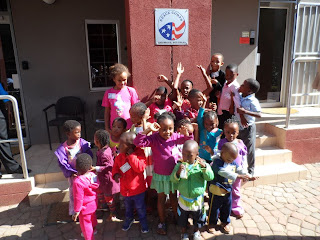
Besides being such a fun day playing with all the kids, it allowed me to see the staff from a more humanist perspective. Yes, we are all a family here - staff and PCVs - but it becomes a more powerful connection when you open up and see these more intimate moments. Knowing that I'm going to be working so closely with them in the upcoming year, I feel this was the perfect opportunity to share something deeper and I feel fortunate to have had the opportunity. Also, have I mentioned that I like playing with adorable kids? Because their energy and excitement over it all really makes it worthwhile. Totally.
PCI Head Start
Last week, after submitting my updated resume, one of the staff from PCI called and asked if I would be willing to attend a meeting put on by UNESCO (United Nations Educational, Scientific, and Cultural Organization) and UNDP (United Nations Development Programme). The meeting was being called to review and revise a toolkit for HIV prevention and treatment for adolescents - a facilitator's guide for trainers, a manual for teachers, and three separate workbook for adolescents (ages ranging between 10-years-old and 19-years-old). Essentially, there is a pre-existing toolkit that has been being used in South Africa, Zimbabwe, Zambia, and other Southern African nations, and they are hoping to implement something similar in Botswana. To do this, they asked a group of experts to assemble and adapt the current documents to something usable here.
The room was literally full of the best minds Botswana has to offer and some of the highest government officials. They ranged from the heads of NACA (Botswana's National AIDS Coordinating Agency), the Ministries of Education and Health, and Baylor Children's Clinic to directors of some of the key national and international NGOs dealing with adolescent health issues in the country. I felt like a very small face in this specialized crowd and wondered why I had been invited to join this meeting. I resolved to try my best to contribute and to learn as much as I could during the meeting, in the hopes of being a valuable resource in the future.
By the end of our first reading of the documents, the representatives in my group were providing me with accolades for my insights and all that I had to offer in terms of contextualizing the document for Batswana youth and for organizational structure and ease of use. It seems that my work on the ground and in the villages has provided me with keen insights often overlooked at this higher level that were extremely useful in revising the toolkit. To the point that the project head from UNESCO asked me if I would be willing to continue my revisions after the meeting because they wanted to get it finalized and begin implementation by June of this year.
All of this gave me confidence in myself and in the skills and knowledge I have developed during my time here. I was overjoyed to be in this company and to be able to contribute meaningfully to the project. I was proud of myself and grateful that PCI felt I was a worthy representative for their organization.
So here I am, with less than a month left in my two year contract, preparing and actually starting some activities for my future extension assignments. I am so content with where things are going and full of excitement about the work ahead of me. I think this is really going to be something great!
As I have mentioned before, I will have two assignments when I start my third year: one with Project Concern International (PCI) as a Technical Advisor for their Tsela Kgopo OVC and Gender Project and the other with Peace Corps as a Volunteer Leader. I will officially begin my new assignments on July 1st. But, as you likely could infer from my ramblings over the past two years, I have never been one for "going with the grain", so to speak. My natural instinct is to gather all the information available and dive head-first into whatever lies before me. This has served me well in the past so it is no surprise that I would do the same again here in Botswana with my third year assignments.
PCVL Head Start
Two weeks ago, my Country Director called and asked me if I would be willing to help plan and host a "Take Your Kid To Work Day" at the Peace Corps office. My role would be to come up with the agenda and activities, coordinate volunteers, and facilitate the day. A chance to play with adorable little kids all day and call it "work"?! Of course I agreed!
In collaboration with the office's Executive Assistant, I planned the agenda for the day. We decided to make it like a real work day for the kids (aged 3- to 10-years-old). They would get "official" nametags with the Peace Corps insignia and the title "Junior Staff" presented at a mock staff meeting in the morning, where they would also take their Oath of Service alongside their parents and other staff. They would go on to receive "medical clearance", complete with watching their heartbeat on a monitor, then go through "security check", which meant learning about basic safety then learning how to use an air horn and put out a real fire with a fire extinguisher! The rest of the day required them to be "Program Support" for the different sectors their parents worked in. Activities included shredding paper (big fun for a little kid!), stamping envelopes, and making friendship bracelets and doing crafts (to help come up with fun activities for PCVs to do with kids in their villages, of course!).
Besides being such a fun day playing with all the kids, it allowed me to see the staff from a more humanist perspective. Yes, we are all a family here - staff and PCVs - but it becomes a more powerful connection when you open up and see these more intimate moments. Knowing that I'm going to be working so closely with them in the upcoming year, I feel this was the perfect opportunity to share something deeper and I feel fortunate to have had the opportunity. Also, have I mentioned that I like playing with adorable kids? Because their energy and excitement over it all really makes it worthwhile. Totally.
PCI Head Start
Last week, after submitting my updated resume, one of the staff from PCI called and asked if I would be willing to attend a meeting put on by UNESCO (United Nations Educational, Scientific, and Cultural Organization) and UNDP (United Nations Development Programme). The meeting was being called to review and revise a toolkit for HIV prevention and treatment for adolescents - a facilitator's guide for trainers, a manual for teachers, and three separate workbook for adolescents (ages ranging between 10-years-old and 19-years-old). Essentially, there is a pre-existing toolkit that has been being used in South Africa, Zimbabwe, Zambia, and other Southern African nations, and they are hoping to implement something similar in Botswana. To do this, they asked a group of experts to assemble and adapt the current documents to something usable here.
The room was literally full of the best minds Botswana has to offer and some of the highest government officials. They ranged from the heads of NACA (Botswana's National AIDS Coordinating Agency), the Ministries of Education and Health, and Baylor Children's Clinic to directors of some of the key national and international NGOs dealing with adolescent health issues in the country. I felt like a very small face in this specialized crowd and wondered why I had been invited to join this meeting. I resolved to try my best to contribute and to learn as much as I could during the meeting, in the hopes of being a valuable resource in the future.
By the end of our first reading of the documents, the representatives in my group were providing me with accolades for my insights and all that I had to offer in terms of contextualizing the document for Batswana youth and for organizational structure and ease of use. It seems that my work on the ground and in the villages has provided me with keen insights often overlooked at this higher level that were extremely useful in revising the toolkit. To the point that the project head from UNESCO asked me if I would be willing to continue my revisions after the meeting because they wanted to get it finalized and begin implementation by June of this year.
All of this gave me confidence in myself and in the skills and knowledge I have developed during my time here. I was overjoyed to be in this company and to be able to contribute meaningfully to the project. I was proud of myself and grateful that PCI felt I was a worthy representative for their organization.
So here I am, with less than a month left in my two year contract, preparing and actually starting some activities for my future extension assignments. I am so content with where things are going and full of excitement about the work ahead of me. I think this is really going to be something great!
Thursday, March 21, 2013
Wednesday, March 6, 2013
Extension Granted!
Despite incessant (and inconvenient) water and power outages, hairy spiders, ant hordes, insane temperatures, and thorns in my shoes, I love it here. Yes, I said it, I love Botswana. I have fallen in love with the simple life in the village and with international development work. Although I had a hunch before coming here that this might be the case, there really was no way for me to predict how deep my love would be. And, honestly, my trials at the beginning definitely pointed more towards "enmity" than "love". But this love has grown from frustration and disappointment and perseverance and is likely stronger because of it. It is like your favorite romantic comedy movie - girl wants to find love, girl sets out to find it, girl is angry with and/or hates what is set in front of her (usually a guy, in this case the work), girl fights it, girl feels like all hope is lost, girl has a realization or transformation, girl flirts with the thing she once resented, and finally girl realizes it's the only thing for her. I didn't think this sort of romance happened in real life. But, like many people before me, I have been surprised by the way things turn out. This could very well be the tale of my pursuit and my love of international development work.
But I made it! I saw the light at the end of the tunnel, my heart flickered, and I got a warm fuzzy feeling with every person who learned something from me and with every organization that ran a little smoother. And that is why, with a joyous heart and an excited mind, I announce that my application for extension was granted! I have been given the opportunity to continue pursuing this love and see where the next phase in the journey takes me!
For my extension year ("third year"), I am assuming two roles:
In my first role, I will be working with Project Concern International (PCI). PCI is an international non-governmental organization that currently operates in 16 countries to promote sustainable change and community development. I will be working directly with two projects funded by USAID - one for orphans and vulnerable children and the other for integrated childhood and youth development. In this capacity, I will get the opportunity to oversee and manage high level projects that I am passionate about, work alongside leaders in their field, and also continue doing some field work with PCI's 10 implementing partners across Botswana.
In my second role, I will be acting as a Peace Corps Volunteer Leader (PCVL). The role of a PCVL is multifaceted and includes: working with Peace Corps staff to assess organizations and villages for successful site development; mitigating issues between staff, volunteers, and host country nationals; assisting with regional support issues; designing and conducting trainings for incoming volunteers; liaising for Peace Corps Botswana, connecting staff with volunteers; and informing current PCVs about available resources to better assist their host country agencies. I am passionate about Peace Corps' mission and believe that every volunteer deserves the best chance to make the most of their service. I am thrilled to have the chance to put my magnanimous experience to work in helping serving volunteers.I am overwhelmed and excited about the potential for personal growth and the opportunity to continue doing good work at an even greater magnitude in these new roles. To me, it is my perfect placement. I have incredible hopes for this country, its people, and the work Peace Corps is doing. I know these hopes are achievable because, time and again, my dreams in this country have come true. I am honored to have the opportunity to stay here one more year to see that continue to happen.
Subscribe to:
Posts (Atom)


