
Thursday, March 7, 2013
PULA!
Almost as if the universe realized my village needed a "pick me up" yesterday, it rained. At about 8pm, I heard the thunder roaring from somewhere in the distance and by 10pm, despite not having power, the village lit up with the lightening strikes. And then, at about 1am, the most incredible thing happened. I was awaken by the sound of people laughing and talking. I reached for my glasses and scurried half asleep to the window to see what the commotion was about. It was still pouring rain so it took a minute for my eyes to adjust but, during a lightening flash, I saw it. Dozens of people were outside, singing and laughing and talking merrily, with buckets in their hands! Just as I have done before, the community allowed nature to help them fix a problem that the government could not. And they were joyous. I picked up my bucket and I joined them for a while - giggling and stomping through puddles like a child. It was one of those Peace Corps moments that you just can't beat! PULA!

Wednesday, March 6, 2013
Water Problems Continue
In America, having potable drinking water and a constant water supply is never a problem. Almost magically, it is there whenever you need it. If you have followed my story, however, then you know this is not the case in Botswana. I have gone months on end without water and have, on occasion, put buckets outside to catch precious rain water. Some of my peers have to walk up to 5km to fill up buckets to carry home because they don't have running water or a water pump nearby. Water is an issue.
Volunteers in Botswana are lucky, though, in that our water has been safe to drink. I have been drinking it straight from the tap for nearly two years and have had no problems at all. That was until recently, when a number of random quality tests were conducted and the water failed to meet US Embassy standards. They advised us that water in my region intended for human consumption should be boiled. Before receiving this statement, I had been having some stomach problems (eww) so I started boiling my water and they ceased. Boiling water is laborious, especially during the heat of summer when all you want is something cold to drink. As of last week, after talking with a health specialist who told me the situation had been cleared up, I have stopped boiling my water. Gratefully, my tummy has not been rattled so I believe she was right and the water is fine now. (After all, the best way to find out is to try it out and my body isn't reacting...) Happy day, right? Wrong. As annoying as it is having to boil water, it pales in comparison to the alternative... no water.
Today the Water Utilities Corporation released the following statement: "The Water Utilities Corporation (WUC) would like to inform residents of Gaborone City and surrounding areas (Mochudi, Gabane, Kumakwane, Mogoditshane, Tlokweng, Lobatse and their surrounding areas) that it is currently experiencing water supply challenges. Due to this, they will experience low pressure to no water at all indefinitely. Residents are advised to wisely use the little available water." INDEFINITELY?! We are going to be without water indefinitely?! To my great dismay (but not to my surprise), this public statement came out AFTER the water cuts arrived in my village, meaning that none of us had the time to prepare. We are already without water and now without means of stocking up. While we all live with water challenges every day, this is incredibly difficult to hear. Although Peace Corps Volunteers hoard water like it's our jobs, there is never enough for our "shorter" week-long outages. It is in these moments when I wish I had a pit latrine because at least then I could go to the bathroom in peace without worrying about using 3L of water to flush... The question then becomes: "What happens to us and to the local communities if the water really is out indefinitely?"
I beg all of you back in America, please cherish every time you turn the faucet on and water comes out and that it is clean water to drink. I will never take those things for granted again.
Extension Granted!
Despite incessant (and inconvenient) water and power outages, hairy spiders, ant hordes, insane temperatures, and thorns in my shoes, I love it here. Yes, I said it, I love Botswana. I have fallen in love with the simple life in the village and with international development work. Although I had a hunch before coming here that this might be the case, there really was no way for me to predict how deep my love would be. And, honestly, my trials at the beginning definitely pointed more towards "enmity" than "love". But this love has grown from frustration and disappointment and perseverance and is likely stronger because of it. It is like your favorite romantic comedy movie - girl wants to find love, girl sets out to find it, girl is angry with and/or hates what is set in front of her (usually a guy, in this case the work), girl fights it, girl feels like all hope is lost, girl has a realization or transformation, girl flirts with the thing she once resented, and finally girl realizes it's the only thing for her. I didn't think this sort of romance happened in real life. But, like many people before me, I have been surprised by the way things turn out. This could very well be the tale of my pursuit and my love of international development work.
But I made it! I saw the light at the end of the tunnel, my heart flickered, and I got a warm fuzzy feeling with every person who learned something from me and with every organization that ran a little smoother. And that is why, with a joyous heart and an excited mind, I announce that my application for extension was granted! I have been given the opportunity to continue pursuing this love and see where the next phase in the journey takes me!
For my extension year ("third year"), I am assuming two roles:
In my first role, I will be working with Project Concern International (PCI). PCI is an international non-governmental organization that currently operates in 16 countries to promote sustainable change and community development. I will be working directly with two projects funded by USAID - one for orphans and vulnerable children and the other for integrated childhood and youth development. In this capacity, I will get the opportunity to oversee and manage high level projects that I am passionate about, work alongside leaders in their field, and also continue doing some field work with PCI's 10 implementing partners across Botswana.
In my second role, I will be acting as a Peace Corps Volunteer Leader (PCVL). The role of a PCVL is multifaceted and includes: working with Peace Corps staff to assess organizations and villages for successful site development; mitigating issues between staff, volunteers, and host country nationals; assisting with regional support issues; designing and conducting trainings for incoming volunteers; liaising for Peace Corps Botswana, connecting staff with volunteers; and informing current PCVs about available resources to better assist their host country agencies. I am passionate about Peace Corps' mission and believe that every volunteer deserves the best chance to make the most of their service. I am thrilled to have the chance to put my magnanimous experience to work in helping serving volunteers.I am overwhelmed and excited about the potential for personal growth and the opportunity to continue doing good work at an even greater magnitude in these new roles. To me, it is my perfect placement. I have incredible hopes for this country, its people, and the work Peace Corps is doing. I know these hopes are achievable because, time and again, my dreams in this country have come true. I am honored to have the opportunity to stay here one more year to see that continue to happen.
Friday, March 1, 2013
Whoa! We Made It! Bots 10 COS Conference


While the emotions of our COS Conference are among the highlights, they are not the sole purpose of the week. More seriously, the conference serves as an opportunity to prepare for the goodbyes in our villages and the transition back home. It is a time to construct our "elevator speech", knowing that most people will not want the full account of our two year hiatus, and learning how to quantify our work and cope with the many changes in ourselves and in the world we left behind.

And, finally, how do you say goodbye? How do you say goodbye to people who have been your main source of support and friendship in an unfamiliar land? How do you thank strangers that took you in as family? How do you leave a village whose paths welcomed you home every day? Most of us won't return to Botswana again. These goodbyes will tear at the heartstrings of even the most jaded of us. And this is our next big challenge and what we will focus on in our final months at site. Just 80 days until departure...
Thursday, February 28, 2013
Students Learn About Life In The Village
A local friend of mine, who is a teacher at an international school in Gaborone, came to me a few weeks back and told me about a unit her class was doing on "children around the world". The aim of the unit was to teach her students about difference and similarities among children in the far reaches of the globe. This lesson was exceptionally pertinent to this class, as her students hail from many continents (all, however, seeming to come from some privilege). She expressed that she wanted her class to learn more about the children in Botswana, of which many had no direct knowledge, and to gain some sense of civil responsibility. We decided that the best way forward was for her class to come to the OVC Pre-School at my NGO and spend a day playing and interacting with the children.
In the weeks leading up to the event, my friend explained to her class about "orphan and vulnerable children status", what life was like in the village as compared to the capital city, the nature of giving back, and the magnitude of even small efforts for those who have so little. In this spirit, her class put on a bake sale to raise money to donate to my NGO and held a drive for clothes, games, toys, and other sundries.
 When the day of the event came, the students arrived in a combi followed by a truck full of their collections. It was like Christmas morning for our center! They brought so many things that the staff and children both burst into tears. One by one, the visiting students took giant packages from the truck and laid them before us. It was unmatched by any other donation. In all the time I have been here, I haven't seen such a display of love and generosity. And, I have to state, that since the gifts were brought to our center, the children have been playing with them and learning so much (they have even learned how to do puzzles!). It's been so exciting for all of us.
 After some opening remarks by our Coordinator, the children were free to interact and get to know one another.
The visiting students and our children buddied up to either play on the gym equipment outside, to color pictures, or to play soccer or other games in the yard. It was a day full of insurmountable laughter and one that I imagine will not soon be forgotten by anyone present.
Here are pictures from the day's festivities:


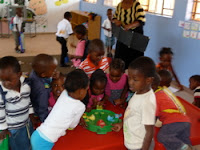


Ultimately, this day of fun was one that expanded the hearts and minds of everyone involved. It ended up being more than just a day within a unit for the visiting classroom but encompassed a world of giving of time, resources, things, and of love. Both sets of students learned about gratitude. And we learned that, despite circumstance, we really aren't all that different. After all, everyone likes a good time!

In the weeks leading up to the event, my friend explained to her class about "orphan and vulnerable children status", what life was like in the village as compared to the capital city, the nature of giving back, and the magnitude of even small efforts for those who have so little. In this spirit, her class put on a bake sale to raise money to donate to my NGO and held a drive for clothes, games, toys, and other sundries.

The visiting students and our children buddied up to either play on the gym equipment outside, to color pictures, or to play soccer or other games in the yard. It was a day full of insurmountable laughter and one that I imagine will not soon be forgotten by anyone present.
Here are pictures from the day's festivities:


Tuesday, February 19, 2013
Mirror, Mirror
Mma Leburu: "Kamogelo, will you please bring your camera to the center tomorrow?"
Me: "Of course. But why? What are we taking pictures of?"
Mma Leburu: "I want to show the kids what they look like. They need to learn how to identify themselves."
Me: "Ooooook? Explain..."
And this is how I learned that most of the orphans that attend my NGO's pre-school don't know what they, themselves, look like. The walls of their homes don't have mirrors to look into and having a personal camera is something they could never imagine. Outside of a fluke reflection of themselves in a passing window, the children have never seen themselves before.
When I took their individual pictures the following day and showed them, their faces lit up in awe and amazement. They would look at me and then look at the picture and then smile huge smiles as they pointed at themselves and called their friends over to see too. Afterwards, I took a series of group pictures of all the kids in the classroom. When it came to the group pictures, the kids had an easier time pointing out their friends than finding themselves. It was like a "Where's Waldo" game but only this time the ever-hiding Waldo was them.
Knowing what you look like is something we all take for granted. At least I did. Like many of my friends, I had floor-length mirrors growing up and could easily nit-pick on the details of my physique, which I knew all too well. Coming to Botswana, this changed drastically. It took a while to adjust to having only a small face-sized mirror and rarely knowing how I looked. But I gave up worrying about a lot of things and I adapted to a simpler life. I now know that even my small mirror is more than what most have here. Oh the things we take for granted...
I told this story and my recent realization to a generous man who stopped by my NGO today. He has agreed to donate mirrors (among other things) to hang at the center so the children can see themselves and begin to recognize who they are. I'll be honest, I can't wait to watch them the first time they witness their own movements. It's going to be a big biiiiiiig day!
Monday, February 18, 2013
HIV Gets Personal
Botswana is a country plagued by HIV. It is estimated that nearly a third of the country is infected, although those of us working at the village level believe this is likely a very conservative estimate. And that doesn't even begin to take into account the devastation the disease has brought on the rest of the populous, most notably the children who are often orphaned and those loved ones who are left to assume the burden. The country has set lofty goals to eradicate the disease but, unfortunately, seems to be falling short. This is why Peace Corps is here. We are here to work in the health sector - improving organization's capacity to help - and to inspire and motivate children and youth to live healthier lives. As such, we meet and befriend many people who are living with HIV.
The work I am doing in Botswana puts me in direct contact with numerous people who are HIV positive. Whether it be through assisting my NGO and the Clinic with improving home-based care services, collaborating with the Support Group on projects, or playing with children affected and infected, I have gotten to know so many individuals whose lives are forever impacted by the disease. It has opened my eyes and my heart in ways I could never have expected.
That being said, there has always been some semblance of distance. Although they are people that I work with all the time and who I care about, I have been able to look at them as colleagues or smiling children first and let the disease take a backseat. I don't often have to see the deterioration nor experience first-hand its impact. Their HIV status is only one aspect of who these people are and, honestly, it isn't all that important. As long as they are taking care of themselves - adhering to their ARV regimen, eating nutritiously, and being supported by family/friends/caregivers/my NGO - then we can all carry on with our lives as normal. That is, until two weeks ago...
Two weeks ago a very dear friend of mine sent me a text message that said "Kamogelo, I am having a very serious problem. I am not sure when I will be coming back but I need you so I will find you when I return." I frantically tried calling her but she did not answer. I waited (im)patiently for nearly a week before I heard from her. When I did, she assured me that she was okay but that she wanted to talk in person.
With nervous hugs and hand-holding, she carefully told me that her husband of nearly twenty years, who had been very sick lately, underwent a series of tests at a nearby hospital. After ruling out prostate cancer and a slue of other things, he finally succumbed to an HIV test and learned that he is HIV+. In shock, he refused to get his CD4 count read to find out if he should start ARV treatment, despite urging by the doctor and my friend. My friend said that what happened next was an almost psychotic episode by her husband, who left the hospital before he received HIV counseling and demanded they go directly to their lands in the Kalagadi. He then refused to say anything more on the matter, would not discuss his newfound status, and began making ridiculous requests and talking gibberish. This lasted for four days.
With nervous hugs and hand-holding, she carefully told me that her husband of nearly twenty years, who had been very sick lately, underwent a series of tests at a nearby hospital. After ruling out prostate cancer and a slue of other things, he finally succumbed to an HIV test and learned that he is HIV+. In shock, he refused to get his CD4 count read to find out if he should start ARV treatment, despite urging by the doctor and my friend. My friend said that what happened next was an almost psychotic episode by her husband, who left the hospital before he received HIV counseling and demanded they go directly to their lands in the Kalagadi. He then refused to say anything more on the matter, would not discuss his newfound status, and began making ridiculous requests and talking gibberish. This lasted for four days.
After returning to the village, my friend's husband holed himself away inside the house. He got even more sickly. He continued to refuse counseling or to get his CD4 count tested. My friend begged him to talk about his status with her or with a counselor from the Clinic or with a trusted friend. She hasn't been able to process her own feelings about his new status because she has been so overwhelmed with helping him grapple with it. She is constantly worried about him.
This is the first time I have witnessed this side of HIV - the emotion, the turmoil, and the tragedy before the recognition and acceptance. To listen to my friend talk about the struggles she is going through and how hard it is for her and her husband to come to terms with things has been heart-wrenching. This is someone who I deeply and profoundly love and she is going through something I cannot even fathom and I don't even have any point of reference. Everyone I know who is HIV+ have already come to terms with their illness to the point where it's practically a nonissue. And every time I ask her how she is doing and how she is coping, she (of course) brings the concern back around to her husband. It is devastating to feel so helpless. I can only imagine how they must feel.
I am humbled that she chose me to talk to and believes in our friendship enough to share this burden with her in some way. Right now, all I can offer her is hugs, which she says is enough.
I am humbled that she chose me to talk to and believes in our friendship enough to share this burden with her in some way. Right now, all I can offer her is hugs, which she says is enough.
Tuesday, February 12, 2013
"Terrific Tuesday" Tales
I entitled this post "Terrific Tuesday Tales" because today's "tales" (i.e. updates) are terrific... and it is Tuesday. Self-explanatory, I suppose, but I felt it warranted pointing out. This is most likely because I felt a desperate need to use an alliteration but wanted to let my readers know there was a reason for it and not just because I'm a great big dork (which I am). (Don't judge me: I worked at a summer camp, I make friendship bracelets with every kid I know, and I hang out with children every day - it's practically a prerequisite to like alliterations and other goofy things!) Honestly, I called the post this because I wanted to very simply "shout out loud" that life in the village is moving ahead terrifically!
For starters, I was awoken this morning by a phone call from my Country Director. He called specifically to discuss my application for extension. He clearly stated that our post is still waiting for funding approval for future extendees from Headquarters in DC and therefore cannot officially issue offers for third year extensions to anyone yet, but that he wanted me to know that my application was very well done and that I am "a highly qualified candidate" for my proposed extension. He went on to say that discussions about placement for all volunteers who are selected will begin as soon as the funding is approved. Knowing more about the process and the stages makes a huge difference for my mental well-being as I approach our COS Conference and look towards the next year. I feel like I can breathe a big sigh of relief knowing that I will likely be continuing the great work being done in Botswana for a third year. (I hope!)
Next, an update on my house-building project. As things so often go, costs of materials have fluctuated (mostly on the upswing), which has caused some delay in purchasing the last of the pieces we need for the house. That being said, we are moving forward with the project and should only be delayed about a week. The cement has been laid for the walls and floors, the windows went in today, the doors and locks (extra heavy duty) should be purchased by Thursday and installed over the weekend, and then all we have left to do is link the pre-existing single-room structure to the newly built home. We are doing this by putting a tin roof cover between the buildings and laying concrete between them. We are also going to construct a small outdoor kitchen in this section. This is a significant improvement for the family, as they have currently been preparing all meals over an open flame outside. Also of improvement, I was able to get mattresses donated for the family. That means that each of those children will have their very own mattress in their new home. Far cry from the blankets they share curled up on the floor right now! Finally, as I mentioned before, the hole for the pit latrine has been dug out and we have purchased the bricks and cement to build the structure. We have manpower together to construct it over the weekend as well. So, barring any further delays, we are hoping the entire structure (sans electricity at this point) will be ready for "handing over" by the end of next week. Wow.
Some months back, I wrote two proposals to a local foundation. I hadn't heard much since submitting them, despite many attempts to follow up with the foundation. That is until this afternoon when my phone rang (yet again) and I answered to find a representative from the foundation on the line. She was calling to inform me that the selection team met earlier this morning to discuss the first of my proposals, which requested a combi (van-like vehicle) to transport the children and patients that are enrolled in programs at my NGO. She went on to state that, after much discussion on my center, they were awarding us our request! This means that my NGO will be getting a shiny new (BRAND NEW) combi! This will help us so much. Not only because our current combi is ancient and costs us a lot in repairs, but also because we have created an income-generating plan for our old combi. Although it has "old car" problems, it's still operational. We are hoping to rent it out for a small daily fee, renters paying for petrol and maintenance, which would be able to go back into programs and increase our sustainability. But, no, the greatness of this phone call does not end here! The foundation representative that called went on to say that a visitor I had hosted at our center spoke highly of our work and our proposal was so well done that they are going to move it to the top of their list to review at their next meeting in May. She insinuated that they already wanted to approve it! The foundation needs to clarify some of their policies on their funding but, if this does happen, my NGO stands to get operational costs, including staff salaries (everyone is unpaid and works voluntarily right now) and two additional staff positions to alleviate the burden and scale up services. Now wouldn't that be a huge leap forward for our center?!
Finally, I am helping to organize an international public service program for a distinguished businessman who contacted me specifically because of the work I have done and asked for my assistance. Although I can't get into the specifics quite yet, the program will be aimed at educating people on grassroots development and hands-on service and hopefully create a global environment for giving back. Stay tuned, especially other PCVs because I may be calling you to host a small gathering or talk at your organizations to discuss the work you and your centers do!
In the words of my NGO's coordinator... "We just have to sing and dance and make a joyful noise!" Today's been a good day!
Tuesday, February 5, 2013
Bots 10 Ramblings: Approaching The End
Over the weekend, I had a number of friends from Bots 10 over to my house. These friends came from all corners of the country to start souvenir shopping at my village's artist colony, attend a "cultural event", and catch up with one another. It was a lot of fun and reminded me of how lucky I am to be a part of my "elusive" group. We are "concentrated awesome", as one group member put it.
Of course, the conversation eventually came around to our upcoming COS Conference and a reflection on our services. We discussed Peace Corps and this whole crazy experience - the ups and downs, the things that motivated us and challenged us these two years, what we have gotten out of it, and the internal versus external measures of it all. After some time, one of us stopped and said "Can we please just acknowledge that this was really hard?" That statement paused the conversation for a minute because it was like a weight getting lifted off of us in a way - a relief - like fiiiiiiiinally, someone said it!. No matter how many accomplishments we have or how productive our service, this whole thing is really hard! And I have been thinking about that statement ever since.
As Peace Corps Volunteers, we spend so much time integrating and accepting things as they are and trying, trying, trying to become part of the community and to "forget" about life back home because it's just not our lives anymore. Things here that would have been extremely challenging in "our past lives" are so commonplace now that we hardly even notice anymore. For instance, we were having this conversation by candlelight because the electricity was out (again) and we never thought twice about it. We just got up, lit some candles, and continued on. But we forget how hard some of the things we have been through truly are because it is our lives now and we have accepted it. Things like being without water and/or electricity for weeks on end, riding a bus for ten hours with people sitting on your lap in 100 degree weather just to see a friend, being delayed because of cows crossing the only tarred road, having to go to multiple offices in multiple villages using public transportation to get all the required signatures just to get a P100/$13 reimbursement, always being on display like a movie star, and so on. These things hardly even phase us anymore. And that's only a sample of the "simple" "everyday" things we deal with here that make it "hard". That doesn't include everything we gave up and are missing out on at home - weddings and births and family and engagements - or the long long loooooooong hours wishing someone from home would send us a package or a card or an email just to let us know they're thinking about us. And the even longer hours spent alone, in silence, with nothing to keep us company but our thoughts (making the before-mentioned even more exasperating).
We don't usually allow ourselves to think about how challenging Peace Corps service can be. This is mostly because it can be too consuming and then you may miss out on all the great things about living here and all the positive outcomes, mostly within ourselves, that could never be replaced. You get used to it, you move forward, and you make the most of your time here.
We all agreed that it is a weird feeling to be nearing the end of our service. It is exciting and rewarding and feels like a major accomplishment, especially when we allow ourselves a minute to think about how hard it is. If you haven't been through it - actually lived in a village and had a long-term experience like this - you can't truly understand, which is why it helps to have the camaraderie of your group-mates, your peers, and the Peace Corps community. This is an experience unlike any other. It is rewarding and you grow as an individual in very meaningful ways. But it will also challenge you to your core and on so many levels. It was a relief to have someone finally say it aloud so we could acknowledge it and be proud of ourselves.
"Next Steps" for Extension?!
In the spirit of keeping everyone informed via the blog-o-sphere, I figured I would share the latest piece of news I have regarding extension. Unfortunately, it isn't a big announcement so don't get too excited but it is all I have for now. What I have learned, as a result of the famous "Peace Corps Grapevine", is that our Country Director and our Director of Programs and Training (who we submitted our extension applications to) should be contacting all applicants by Friday to discuss "next steps" regarding extension.
There is no word yet what "next steps" actually means but, we assume, it implies that staff have read our applications and, subsequently, are informing us if we have been accepted by Peace Corps' country staff for extension and will be moving on to the interview phase (where we meet with staff and organizations to discuss project placement) or if if we have been denied extension. Of course, this may not be exactly what "next steps" means, as none of us are clear on the process, but this is what "the grapevine" is saying.
Ultimately, this blog post is merely stating that I will know something about my extension application by Friday... maybe... since this is all third-hand information... but something is better than nothing, right? sigh.
Subscribe to:
Posts (Atom)